Rethinking Migration Categories from the Global South
Background and Scope
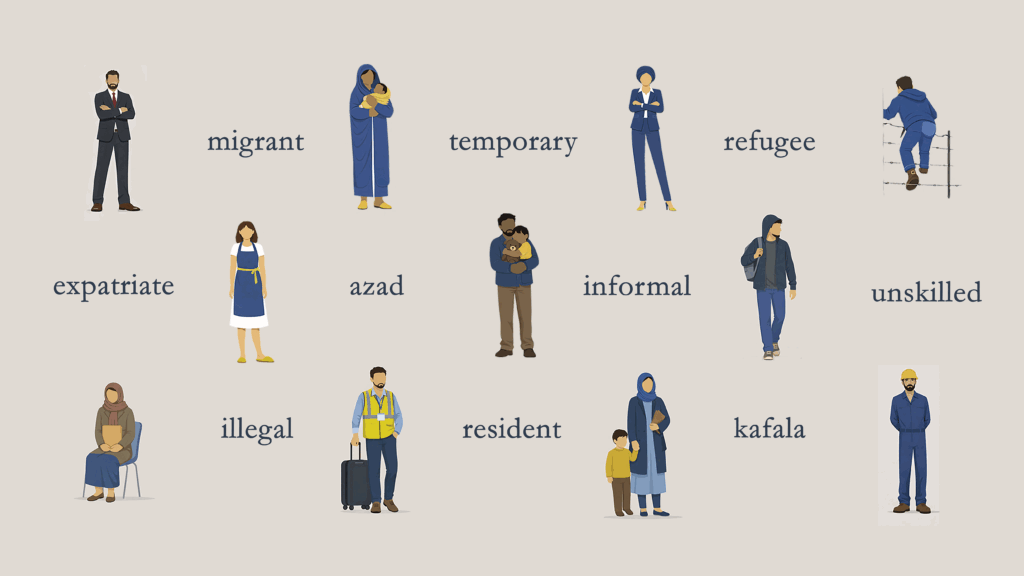
The research cluster is embedded within CIRS’s wider initiative, “Migration Studies from the Global South: Rethinking Theory and Method,” a program structured around a series of interlinked sub-projects that draw on comparative perspectives from multiple regions of the Global South. This cluster aims to advance a critical understanding of the migration categories and classification regimes that shape movements to, from, and within the Global South, and treats classificatory systems not as neutral descriptors but as objects of inquiry in their own right. It interrogates how these systems function as technologies of governance, value production, and social differentiation, echoing interventions by researchers working in Latin America, South Asia, and Africa who have shown how categories like “informal,” “illegal,” or “temporary” actively produce hierarchies rather than merely record them. Through this approach, the cluster seeks to contribute to a body of knowledge that is empirically grounded in Global South experiences and methodologically attentive to the power relations that organize contemporary mobility.
Migrants frequently move across and between multiple legal and social categories over time; the same person may, sequentially or simultaneously, be positioned as a student migrant, a labor migrant, a refugee, an irregular worker, a trafficking victim, and a skilled migrant. Yet administrative and statistical systems, often designed in or for the Global North, require fixed, singular identities that render such categorical mobility invisible, and at times also criminalize it. The project, therefore, insists on understanding categorization as a dynamic, contested process rather than a static classification.
The designation of “skilled” versus “unskilled” labor is treated in this cluster as an inherently political and racialized practice rather than an objective measure of human capital. University-educated migrants employed in so-called low-skilled occupations illustrate how credentials and professional experience are routinely devalued when filtered through nationality, gender, race, and sectoral hierarchies. In this sense, “skill” is not a portable attribute of individuals but a status assigned contextually within particular regimes of value.
Migrants frequently move across and between multiple legal and social categories over time; the same person may, sequentially or simultaneously, be positioned as a student migrant, a labor migrant, a refugee, an irregular worker, a trafficking victim, and a skilled migrant. Yet administrative and statistical systems, often designed in or for the Global North, require fixed, singular identities that render such categorical mobility invisible, and at times also criminalize it. The project, therefore, insists on understanding categorization as a dynamic, contested process rather than a static classification.
The designation of “skilled” versus “unskilled” labor is treated in this cluster as an inherently political and racialized practice rather than an objective measure of human capital. University-educated migrants employed in so-called low-skilled occupations illustrate how credentials and professional experience are routinely devalued when filtered through nationality, gender, race, and sectoral hierarchies. In this sense, “skill” is not a portable attribute of individuals but a status assigned contextually within particular regimes of value.

More striking still is the ideological work around the expatriate versus migrant distinction. Those labeled “expatriates,” typically white, Western, or from privileged backgrounds, are positioned as mobile professionals deserving of generous compensation packages, housing allowances, and social privilege. Those categorized as “migrants,” predominantly from South and Southeast Asia, Africa, and Latin America, are marked as temporary labor, subject to restrictive governance, wage suppression, and social marginalization. This distinction operates not only in Gulf states but across Southeast Asia, Southern Africa, and Latin America, revealing how migration regimes systematically produce differential worth through categorical assignment rather than through any objective assessment of qualifications or contributions.
In Gulf migration regimes, explicit wage scales and mobility restrictions based on national origin institutionalize highly formalized systems of labor stratification. Kafala structures, nationality-based wage tables, and segmented access to social rights reveal how racial capitalism organizes contemporary migration not as an anomaly at the margins of the system but as one of its constitutive features. Yet similar logics operate in Southeast Asian economies where Filipino domestic workers are paid differently than Indonesian workers for identical labor, and in Southern African contexts where professionals from certain countries face systematic credential devaluation. The cluster places these hierarchies at the center of theoretical inquiry rather than treating them as regional exceptions to Northern-derived models. By examining how identical qualifications and work histories are valued differently across nationalities, races, genders, and destination contexts, the project conceptualizes skill categorization as a political tool that legitimizes hierarchical migration governance.

The proliferation of visa arrangements that create legal presence alongside irregular or semi-legal employment provides a particularly revealing lens for examining the instability and political work of migration categories. They thereby create a form of legally sanctioned presence that coexists with irregular or semi-legal forms of employment, blurring neat boundaries between “regular” and “irregular” migration. Similar patterns of categorical ambiguity emerge across the Gulf, China, South Africa and Venezuela. These cases occupy and expose the grey zones between legal/illegal, formal/informal, and regular/irregular that this cluster seeks to theorize. Rather than treating the Gulf as an “exceptional” case, the project positions it as one revealing site among several for understanding how categorical ambiguity functions as a mode of governance. This project aims to further examine such to shed light on how classification regimes generate and manage ambiguity. Azad visa holders may be legally present yet “illegally employed,” at once documented and precarious, and often oscillating between the labels of labor migrant, irregular worker, self-employed, depending on the institutional vantage point. Situating Azad visas within broader typologies of sponsorship, temporary labor, and freelance migration allows the project to show how visa categories themselves constitute a field of rent extraction, stratification, and differentiated rights, while also enabling migrants to carve out constrained spaces of autonomy.

Women’s migration, particularly along South–South routes, remains systematically under-counted, misclassified, or rendered invisible in official statistics and much of the scholarly literature. This pattern raises a core epistemological question: do existing categories lack the capacity to capture women’s migration practices, or does their absence represent a form of structured non-knowledge that serves specific political and economic projects? When data infrastructures routinely fail to account for half the migrating population, the issue exceeds methodological oversight and signals a deeper theoretical issue. These absences are forms of “epistemic erasure” that require explanation in their own right.
The project aims to examine how migration regimes themselves are gendered in their construction, how feminized sectors are systematically deskilled, and how women’s mobility is governed in ways that render their economic agency less legible or altogether invisible.
Economic migration scholarship often relies on human capital models that conceptualize skill as an individual attribute, thereby obscuring how credential recognition functions as a gatekeeping mechanism. When women do appear, they are typically framed as a sub-category rather than prompting a rethinking of how migration systems, labor markets, and knowledge practices are themselves gendered. There is, in short, no comprehensive theoretical account that centers categorization as a field of struggle through which state power, market logics, humanitarian governance, and migrant agency intersect.
Against these key gaps in the literature, the research cluster seeks to advance theoretical interventions that reconceptualize migration categorization in Global South contexts as a dynamic, relational, and contested process. It aims to collaborate with scholars whose work moves beyond static frameworks to analyze how migrants simultaneously inhabit multiple categories, transition between them, strategically deploy or subvert them, and forge alternative classificatory practices of their own.

A central query of examination under this cluster is to foreground how migrants themselves understand, encode, and navigate categorical systems. This involves including conceptual vocabularies that migrants use to describe their own mobility, vocabularies that often diverge significantly from bureaucratic and academic categories. Also, understand how concepts from languages from the Global South capture mobility, work, and belonging differently than the English term “migration.” This would include migrants’ own classification practices, the distinctions they make between different types of work, different migration pathways, different degrees of permanence or belonging, and challenge or exceed state-imposed categories.
The project seeks to include approaches capable of capturing categorical fluidity ethnographically and historically, tracing how migrants move through, inhabit, and contest labels across time and space. The cluster intends to link classificatory practices across multiple South–South migration regimes: Gulf sponsorship and Azad visa systems, Southeast Asian migration management architectures, Southern African regional mobility frameworks, and South American governance structures, tracing both context-specific configurations and broader structural commonalities. This comparative lens allows a systematic analysis of how colonial legacies, regional integration projects, development asymmetries, and geopolitical hierarchies shape categorization differently across sites. CIRS aims to publish research papers produced through this cluster as a subsequent publication of a special issue of a journal.