


Sudan
Sudan in the Picture: Research on Sudanese Cinema Workshop I
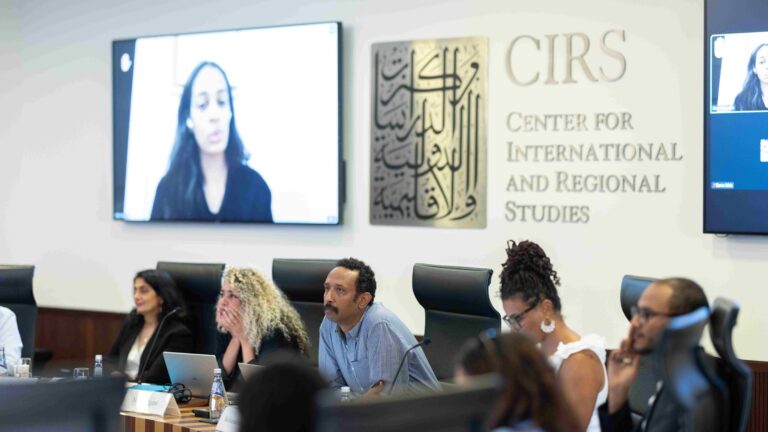
From October 30 to November 1, 2025, the Center for International and Regional Studies (CIRS) at Georgetown University in Qatar (GUQ) hosted a workshop under its research initiative, Sudan in the Picture: Research on Sudanese Cinema. The gathering brought together a diverse group of scholars, academics, artists, filmmakers, and practitioners from across the globe to deliberate on the historical trajectory of Sudanese cinema, as well as emerging cinematic trends amidst the ongoing conflict.
The workshop commenced with a discussion led by Khalid Ali, titled “The Wedding of Zein: A Case Study for Remembering the Past, Informing the Present, and Shaping the Future of Sudanese Cinema.” He explored the collaborative effort between Sudanese author Tayeb Salih and Kuwaiti filmmaker Khalid Al Siddiq in adapting “The Wedding of Zein” into a 1976 film. He underscored this as a groundbreaking Arab-African artistic partnership, fusing literature and cinema to portray Sudan’s multi-ethnic cultural heritage. The film centers on Zein’s wedding as a micro-narrative reflecting Sudanese village life, illustrating the transformations and complexities following Sudan’s 1956 independence, and engaging with themes such as postcolonial evolution, feminism, religion, and cultural diversity. Despite its critical acclaim and international recognition, the film’s external directorship sparked debates regarding cultural authenticity; nevertheless, it remains significant for its role in globally promoting Sudanese culture. His paper aims to connect this film to contemporary Sudanese cinematic works, emphasizing ongoing efforts to restore and analyze its legacy, and advocating for cinema as a catalyst for cultural dialogue and peaceful coexistence in modern Sudan.
Samar Abdelrahman then presented “Repairing the Audiovisual Archive: Hussein Shariffe,” which is rooted in a multidisciplinary project. This initiative focuses on developing practice-based approaches to African audiovisual heritage restitution through transnational collaborations among partners from Sudan, Egypt, Germany, and the UK. She highlighted the severe threats confronting Africa’s cinematic heritage due to historical, political, and infrastructural challenges, particularly in Sudan. She posited a redefinition of restitution as “archival repair,” characterizing it as a participatory, justice-oriented process that prioritizes preservation, creative access, and the empowerment of affected communities over the mere repatriation of physical artifacts. Utilizing the Hussein Shariffe archive as a central case study, her work seeks to demonstrate how archival survival is intricately linked to issues of displacement, diasporic memory, and intergenerational cultural transmission. The project challenges conventional models of restitution, instead advocating for innovative forms of access, engagement, and collaboration that address current crises while fostering opportunities for Sudanese cinema’s creative future and intergenerational dialogue.
Following this, Abdelrahman Elbashir presented “Sudanese Cinema: A Retrospective Archaeology,” which investigates Sudanese cinema as a crucial cultural and urban phenomenon that shaped social life and collective identity throughout the 20th century. He emphasized cinema theaters as distinctive architectural forms and civic spaces, integral to Sudan’s urban fabric and modernist aspirations, particularly through open-air, climate-adapted designs. His work documents the decline of this cinematic culture due to political instability, censorship, and neglect, leaving behind deteriorating theaters and fragmented archives that serve as potent cultural artifacts. Methodologically framed as retrospective archaeology, the paper incorporates photographic surveys, spatial analyses, and a 3D digital reconstruction of a pivotal theater to reinterpret these remnants. He underscored the imperative for preserving and critically analyzing cinema heritage within Sudan’s broader cultural history and urbanism, also stressing the leveraging of this heritage in post-conflict urban restoration, fostering interdisciplinary dialogue on cinema as urban infrastructure, architecture as cultural memory, and the potential role of cultural preservation in rebuilding Sudanese society.
Frédérique Cifuentes presented “Cinema in Sudan and Its Legacy,” a multimedia project exploring Sudan’s cinematic history through outdoor cinema houses, pioneering filmmakers like Gadalla Gubara, and the Sudanese Film Group. Her work, originating from photographic research of Khartoum’s cinema architecture, aims to preserve this distinctive cultural heritage. The presentation delved into the colonial origins of photography and cinema in Sudan, highlighting their role in documenting and shaping national identity, and underscoring the fragility of these historical archives. She detailed Gubara’s impactful career, from photographer to a pivotal figure in Sudanese cinema, whose work transitioned from government roles to independent productions.
Hatim Eujayl then discussed “The Mother, The Farmer, and the Sheikh: Cinematic Portrayals of Rural Central Sudan,” which analyzes how four films—The Tomb (1977), You Will Die at Twenty (2019), Al-Sit (2020), and Cotton Queen (2025)—depict life in agricultural villages along the Blue Nile. The paper aims to explore how these films utilize cinematic techniques to construct ideas of regional and national identity through portrayals of gender, religion, economy, and tradition. Eujayl argued that rural central Sudan is frequently presented as the archetype of Sudanese authenticity, simultaneously idyllic and patriarchal, where young protagonists challenge entrenched social norms. By examining production contexts, filmmaker perspectives, and ideological messaging, he seeks to uncover how depictions of this region reflect broader political and cultural narratives. Ultimately, the work aims to establish a framework for analyzing regional representation in Sudanese cinema, advancing understanding beyond national generalizations toward nuanced regional study.
Danya Elmalik explored “Sudanese Cinema and the Archive of Tomorrow,” which investigated the fragile relationship between Sudanese cinema and archival preservation, focusing on the erasure, loss, and revival of Sudan’s film heritage. Utilizing Suhaib Gasmelbari’s Talking About Trees (2019) and Sudan’s Forgotten Films (2017) as case studies, the paper aims to examine how films themselves become archives in the absence of formal preservation systems. Drawing on theories such as Schwartz and Cook’s concept of “archives and power” and Marie-Aude Fouéré’s idea of “film as archive,” she contended that Sudanese films now function as cultural records and memory keepers amidst political and economic instability. The paper will highlight the importance of access and digitization, referencing Caroline Frick’s notion of “access as preservation,” to counteract the marginalization of Sudanese history. Ultimately, she frames this work as part of a broader endeavor to safeguard and reimagine Sudan’s cinematic and cultural memory—the “archive of tomorrow.”
Umloda Ibrahim’s presentation, “Return of Sudanese Cinema and its Aesthetics of Resistance,” traced the historical evolution and political dimensions of Sudanese filmmaking, from its colonial introduction to its post-independence growth, decline, and present-day revival. She elucidated how contemporary Sudanese and diasporic filmmakers express resistance and identity through cinema. Analyzing Our Beloved Sudan (2012), Al-Sit (2020), and You Will Die at Twenty (2019), she argued that diasporic filmmakers employ the concept of “homeplace” as a radical political space, shaped by displacement, exile, and hybrid identity. Drawing on Hamid Naficy’s theory of “accented cinema” and bell hooks’ idea of the home as a site of resistance, the paper aims to explore how gender, colonialism, and cultural memory intersect within Sudanese cinematic narratives.
Mamoun Eltlib subsequently traced the rise and decline of Sudanese cinema with his presentation, “Sudanese Cinema: Intersections of Politics and the Dream of the City.” Using personal interviews and historical research, he explained how political events such as socialist-nationalist shifts, Sharia law enforcement, and suppression under the National Islamic Front, profoundly shaped film culture and institutions in Sudan. His work will illustrate the distinct histories of El-Obeid and Atbara, highlighting the cultural vibrancy and civic role of their cinemas before state interventions and censorship began eroding the industry in the 1970s. Interviewees identified the nationalization of film distribution as the onset of cinema’s collapse, exacerbated by a lack of institutional support and creative freedom. The enduring appeal of Indian popular films offered solace to marginalized groups as local production diminished. The paper will consider how the Sudanese “Dream of the City”—reflected in the symbolic place of cinema—can only be fully realized in a true democracy and remains central to Sudan’s collective aspirations for cultural renewal.
In a subsequent session, Raga Makawi and Abubakr Omer analyzed Sudanese image-making in film with their presentation, “Literal Death or Symbolism, the Liberalization of Political Meaning-Making in Sudanese Films.” They highlighted the historically obscure and politically charged nature of Sudanese cinema, examining the sociopolitical context of the 1970s when cultural productivity was dominated by poetry and music, with film largely absent as a medium for reflecting Sudanese history and future. Since the political opening following the 2005 Peace Agreement, Sudanese filmmaking has expanded, particularly in Khartoum, primarily fueled by donor-funded projects aligned with liberal narratives focusing on conflict and resistance. Using the 2019 film You Will Die at 20 as a case study, they scrutinized the tension between local meaning-making and international reception, suggesting that Sudanese filmmakers adapt narratives to conform to dominant global liberal discourses, often resulting in simplified or orientalized interpretations. The paper proposes the development of oral mapping tools to recover richer local epistemologies in Sudanese cinema, aiming to balance external influences with authentic cultural expression and political storytelling. The research is scheduled to proceed through workshops, literature reviews, and data collection through early 2026.
Roman Deckert investigated Sudanese cinema from the perspective of German-language sources with “Sudanese Cinema Behind the German Language Barrier,” which highlighted Germany’s historically significant yet often overlooked role in Sudanese cultural relations. His work aims to overcome the “German language barrier” by systematically researching archival materials in Germany, Austria, and Switzerland pertaining to Sudanese cinema, including Cold War-era cultural exchanges between the Federal Republic of Germany (FRG) and the German Democratic Republic (GDR) that involved Sudan. Key foci include the biography of Mahjub bin Adam Mohamed, an early Sudanese actor in German films, and the influence of controversial figures such as Leni Riefenstahl on Sudanese film. The paper will also explore German contributions, such as the establishment of television in Sudan and film education. Additionally, it will review private archives and rarely seen film footage, revealing complex layers of Sudanese cinematic history connected to German-speaking countries.
Sarra Idris’s presentation, “Double Vision: From Imperial Gaze to Intimate Knowing in Sudanese Cinema,” explored how Sudan’s cinematic representation has evolved from colonial distortion to self-authored storytelling. She traced early depictions, such as Khartoum (1966), which glorified British imperialism while dehumanizing Sudanese characters through caricature and erasure. Even later humanitarian films like The Good Lie (2014) perpetuated the “white savior” trope, centering Western emotional narratives. In contrast, contemporary Sudanese filmmakers reclaim their image, crafting works rooted in memory, resistance, and authenticity despite censorship and resource constraints. Framed through W.E.B. Du Bois’s concept of “double consciousness,” she introduced “double vision”—the tension between Western portrayals and her own lived knowledge as a Sudanese raised partly in the West. Her paper aims to bridge academic analysis and personal reflection, interrogating how film shapes cultural self-perception and exploring cinema as both a site of historical trauma and reclamation.
Roopa Gogineni’s session, “Politics of Collective Filmmaking and Distribution in Sudan,” explored how Sudanese filmmakers utilize collective labor and mutual aid (nafeer) to produce and distribute films amidst censorship, displacement, and war. Drawing on her experience as a documentary filmmaker and coordinator of a mobile cinema network, she employed practice-based research combining oral histories, film analysis, and field observation. She highlighted grassroots initiatives, such as the Kiryandongo Refugee Settlement’s mobile cinema club, which screens films for large refugee audiences and fosters collaborative production. These community-driven practices transform filmmaking into a political and pedagogical act, creating shared spaces for dialogue and cultural resistance. By comparing Sudanese collectives with similar movements in Nigeria, Syria, Brazil, and India, she situated them within global traditions of Third Cinema and activist filmmaking. Her work aims to reframe cinema as a collective infrastructure for social movements, emphasizing collaboration, mobility, and cultural self-determination beyond state and market control.
In the subsequent session, Leena Habiballa discussed “Gendered Representations in Sudanese Cinema,” examining how portrayals of gender and the subaltern in Sudanese films from the 1970s to the present mirror the nation’s shifting social and political realities. Early cinema, exemplified by Gadalla Gubara’s Tajouje (1977), reinforced patriarchal ideals of stoic masculinity. In contrast, recent films such as You Will Die at Twenty (2019) and Goodbye Julia (2023) challenge these norms by presenting emotionally complex male characters grappling with social change and instability. The rise of women filmmakers, notably Marwa Zein with Khartoum Offside (2019), has further transformed representation, foregrounding agency, solidarity, and resistance by subaltern groups against patriarchal and state oppression. She argued that these evolving depictions signify a critical reimagining of gender and the subaltern in Sudanese cinema, where the voices of these groups increasingly shape national narratives and redefine cultural understandings of identity, power, and belonging.
Next, Taghreed Elsanhouri presented “Our Beloved Sudan: Reflexive Ethnographic Enquiry on the Filming of Sudan’s Partition.” She addressed her ethnographically inspired approach to documenting Sudan’s partition through her film Our Beloved Sudan. The project explores how the 2011 South Sudanese self-determination referendum redefined conceptualizations of Sudan as a nation, intertwining public and private narratives by engaging political figures and an ordinary mixed-race family experiencing national division. She emphasized a dialogic process, treating filmic inquiry as an ethnographic encounter, examining how Sudanese people articulate nationhood, memory, and identity at a historical crossroads. Drawing on theoretical frameworks from Edward Said and Bakhtin, she investigated how different voices, both dominant and marginalized, participate in constructing or challenging national identity, emphasizing situated, often contradictory, perspectives.
Mohanad Hashim explored the historical and contemporary challenges facing Sudanese cinema with his presentation, “The Quest for a Sudanese Cinema.” He highlighted the scarcity of archives and resources, exacerbated by the impact of the 2023 war. Historically, Sudanese cinema experienced brief state support in the 1970s and a recent resurgence led by young diaspora and local artists. Early film culture, dating back to 1911 with screenings in El-Obied and flourishing in Khartoum and Omdurman by the 1940s, featured cinema as both entertainment and a political instrument, notably during World War II when colonial authorities used film for mobilization. He stressed the dearth of research on Sudanese audiences, their viewing habits, taste formation, and socio-political influences. He proposes to investigate cinema appreciation and consumption through archival newspapers, magazines, and other sources, aiming to understand how Sudanese cinephiles navigated scarcity, class divides, urban politics, and national identity formation amidst structural challenges to the cinema industry.
Razan Idris presented “Sudanese Filmmakers and Egyptian Audiences: From Decolonization to Displacement,” which examined the often-overlooked history of Sudanese filmmakers working in Egypt throughout the 20th century and their representation of Sudanese identities to Egyptian audiences. She revealed that the well-known Sudanese filmmaker Saeed Hamed directed the 1998 Egyptian film An Upper Egyptian in the American University, which contains anti-Black stereotypes criticized across the Arab world. Her work seeks to uncover how Sudanese filmmakers, many of whom studied or lived in Egypt, have navigated racial, cultural, and political dynamics in their films, both during Sudan’s national struggles and periods of exile. The paper will highlight Sudanese cinema’s diasporic nature, where displaced filmmakers produce work in Egypt, engaging with themes of identity, displacement, and representation amidst political turmoil. The aim is to excavate lost films and histories, questioning how Sudanese cinema abroad has shaped perceptions of Sudanese identity and how this legacy can inform future filmmaking practices within and beyond Sudan.In the final session, Mai Abusalih examined “Khartoum (2025): The City as the Sixth Protagonist,” portraying it as both a documentary portrait of five residents and an exploration of the city as a “sixth protagonist,” shaping their experiences amidst political upheaval. Filmed between the 2019 revolution and the 2021 military coup, the work documents Khartoum’s transition toward intensified militarization and the disruptions that preceded the 2023 war. Through street-level perspectives, the film employs walking as a narrative method to reveal how spatial hierarchies, planning politics, and everyday urban informalities structure life in the capital. Juxtapositions between marginalized peripheries such as Jabarona, an area historically housing displaced communities, and central protest sites highlight the city’s entrenched social inequalities and contested notions of citizenship. Constraints imposed by surveillance and censorship shaped the film’s iPhone-based production, underscoring the tension between public space and state control. She will utilize interviews, mapping, and comparative cinematic analysis to interrogate representation, agency, and the right to the city.
- To view the working group agenda, click here
- To read the participants’ biographies, click here
- Read more about this research initiative
Participants and Discussants:
- Samar Abdel-Rahman, University of Liverpool
- Bayan Abubakr, PhD candidate,Yale University
- Mai Abusalih, Dcomomo Sudan | Modern Sudan Collective
- Khalid Ali, Brighton and Sussex Medical School
- Zahra Babar, CIRS, Georgetown University in Qatar
- Misba Bhatti, CIRS, Georgetown University in Qatar
- Khalid Albaih, Artist in Residence, Georgetown University in Qatar
- Frédérique Cifuentes-Morgan
- Maryam Daud, CIRS, Georgetown University in Qatar
- Roman Deckert, Media in Cooperation and Transition (MiCT)
- Danya Elmalik
- Abdelrahman Elbashir,
- Taghreed Elsanhouri,
- Mamoun Eltlib
- Hatim Eujayl
- Roopa Gogineni
- Leena Habiballa
- Mohanad Hashim, BBC
- Noor Hussain, CIRS, Georgetown University in Qatar
- Razan Idris, University of Pennsylvania
- Sarra Idris
- Umloda Ibrahim
- Raga Makawi, London School of Economics and Political Science
- Suzi Mirgani, CIRS, Georgetown University in Qatar
- Abubakr Omer
- Sabreen Taha, CIRS, Georgetown University in Qatar
Article by Misba Bhatti, Research Analyst, CIRS