


Dialogue Series
CIRS Monthly Dialogue: Nationalism in Transition: From the Regional to the Local
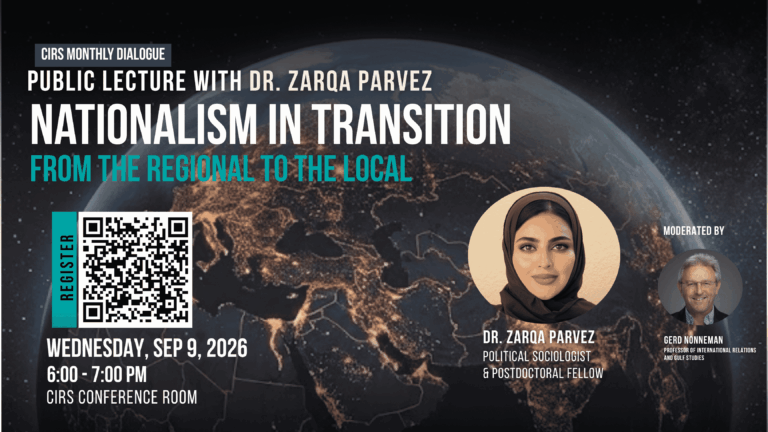
Public Lecture with Dr. Zarqa Parvez
How do we understand nationalism as it actually functions, changing, remerging, reappearing, beyond just a fixed category? This talk explores how nationalism and national identity in the region is being reshaped by several factors: migration, economic change, and generational shift.

Dr. Zarqa Parvez is a political sociologist and social scientist whose research focuses on the
intersections of statecraft, national identity, society, and youth in the Arab Gulf region. Her
scholarship employs intersectional and post-colonial theoretical frameworks to examine state-
society dynamics through the lens of identity politics, and youth engagement, generating
nuanced understandings of Gulf regional dynamics that transcend conventional narratives. She is
currently a postdoctoral fellow at Georgetown University in Qatar She has taught several
undergraduate and several graduate seminars including “History, Politics and Culture of the
Middle East,” “Family and Kinship in the Middle East,” and “Nationalism and National Identity
in Gulf” across Georgetown University in Qatar, Northwestern University in Qatar, Hamad Bin
Khalifa University, and Lusail University. She previously served as the Doyle Fellow for
Inclusion in the Classroom at Georgetown University in Qatar (2023), where she developed
initiatives supporting diverse and inclusive learning environments.
Her published work includes “Women and Family Friendly Practices in the Workplace,”
“Tribalism and National Identity in the Arab Gulf,” “Women and Politics of Sports in FIFA
2022,” and “Post-colonial Nation Building in Gulf.” She serves as an advisory board member for
HAWWA Journal. She collaborates with UC Berkeley’s Othering and Belonging Institute on
research related to identity and belonging in Gulf contexts and contributes analysis to outlets
including Middle East Monitor and Al Jazeera, examining Gulf politics, social dynamics,
women’s agency, and national identity formation. She has participated in regional and
international dialogues including Doha Debates, the Othering and Belonging Conference at UC
Berkeley, and collaborative projects with UN Women and regional think tanks.

Gerd Nonneman is Professor of International Relations & Gulf Studies at Georgetown University in Qatar (GU-Q), where he served as Dean from 2011 to 2016. He holds a Ph.D in Politics from the University of Exeter, and Licentiates in Oriental Philology (Arabic) and Development Studies from the University of Ghent, Belgium. Prior to his appointment at Georgetown, he served as Professor of International Relations & Middle East Politics, and Al-Qasimi Professor of Gulf Studies, at the University of Exeter, where he also directed the Institute of Arab & Islamic Studies and the Centre for Gulf Studies.
A former Executive Director of BRISMES (British Society for Middle Eastern Studies), he is Editor of the Journal of Arabian Studies. He has published widely (in12 books and over 50 articles and book chapters) on the politics and international relations of the Gulf and the wider Middle East, on Muslim communities in Europe and on comparative political and economic liberalization. Aside from his academic work, he has worked in the private sector in the Gulf region, and acted as a consultant to a range of companies, NGOs, governments and international institutions.