


CIRS Lunch Talk: Who Makes Enterprise Possible?
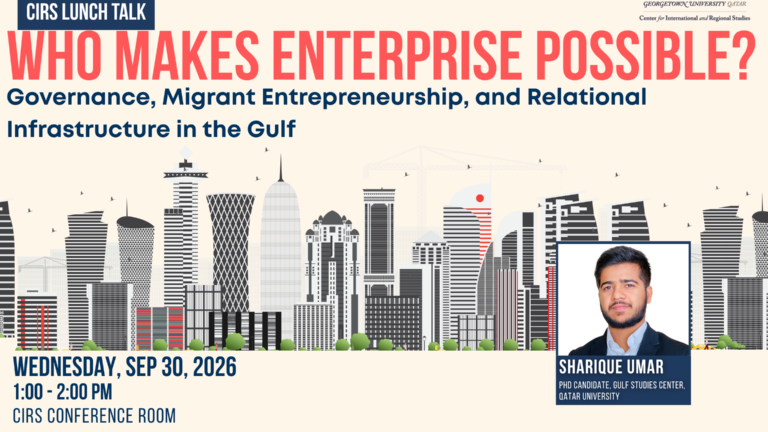
Governance, Migrant Entrepreneurship, and Relational Infrastructure in the Gulf
The Center for International and Regional Studies (CIRS) hosted Sharique Umar, PhD candidate at the Gulf Studies Center, Qatar University, for a talk titled “Who Makes Enterprise Possible? Governance, Migrant Entrepreneurship, and Relational Infrastructure in the Gulf.” Drawing on fieldwork with shopkeepers, restaurateurs, and service businesses in Qatar, Umar asked how migrant-run small and micro enterprises operate when those running them cannot legally own them. He argued that the relationships linking migrant entrepreneurs to Qatari sponsors, intermediaries, and their own communities are not incidental favors. Rather, they function as infrastructure: recurring, load-bearing arrangements without which these businesses would not exist.
Umar opened by outlining the ownership structure. Although Law No. 1 of 2019 opened full foreign ownership, it applies only in permitted sectors, and the capital and paperwork involved place it beyond most small operators. Most therefore continue to operate under the older model, in which legal ownership rests with a Qatari sponsor, or kafeel, who shares in the business’s revenues. The migrant entrepreneur, meanwhile, provides the capital, hires and fires, manages suppliers and credit, and absorbs the losses. The enterprises in question employ up to roughly fifty people, with fewer than ten in the micro category. Told by his interlocutors that opening a business means finding “the right people,” Umar framed his central question: which relationships make enterprise possible, and how are they formed?
Building on the concept of social capital, Umar proposed three criteria for treating a relationship as infrastructure. The first is mediation: the relationship bridges a gap the entrepreneur cannot cross alone, much as a metro connects two points for someone without a car. The second is sustained coordination: it is relied upon repeatedly rather than as a one-off favor, generating trust among all stakeholders. The third is breakdown: like other infrastructure, it remains invisible while it functions and becomes visible only when it fails.
He then traced these relationships across three domains. In the domain of legal access, sponsors are reached through other migrants already operating under them rather than approached directly; one entrepreneur worked with a sponsor for fifteen years before opening his own business, then vouched for several others. Sponsors often hold multiple registrations and deal with operators through an intermediary, or mandoob, who handles licensing, health certificates, and residency paperwork, an arrangement that also serves as a buffer, since operators prefer to avoid direct contact with the sponsor. In the domain of commercial organization, entrepreneurs vet prospective sponsors through their community before committing, and peers help maintain these arrangements, in one case intervening after an operator took a supplier dispute to his sponsor. In the domain of transnational ties, start-up capital is often raised at home, including through land sales; some operators hold liquidity in Qatar while relatives at home advance money to their families; and informal credit extended to customers traceable to a known place of origin produces a cross-border enforcement mechanism.
Umar also examined the migrant entrepreneur’s own transition into the role of a sponsor. On moving from employee to operator, his residency shifts under the business he runs, loosening his dependence on an employer’s contract. He can then bring in family and recruit from his home region, attaining both a social safety net and upward mobility as a “Non-citizen Kafeel”, along with the power to cancel an employee’s residency.
The Q&A addressed why migrants open businesses in Qatar rather than at home, citing prior business experience, the opportunity structure encountered after arrival, escape from contract dependence, and the ability to bring family. Sponsors, Umar noted, gain a share of revenues across a portfolio of registrations, as compensation for real legal exposure. For small and micro businesses, he said, the 2019 reform has largely not changed the picture, owing to sector restrictions, high costs, and the protection sponsorship provides when problems arise. Migrant businesses both fill gaps and create markets, forming the backbone of local commerce, serving a majority-migrant population, and employing large numbers themselves. Discussion also turned to the implications of this hierarchy, including employees changing employers under pressure, third-party residency arrangements used as workarounds, and a case in which a sponsor transferred a business while the operator was abroad.
Article by Maryam Daud, CIRS Administrative Assistant


