


Dialogue Series
Book Talk: Remittance as Belonging
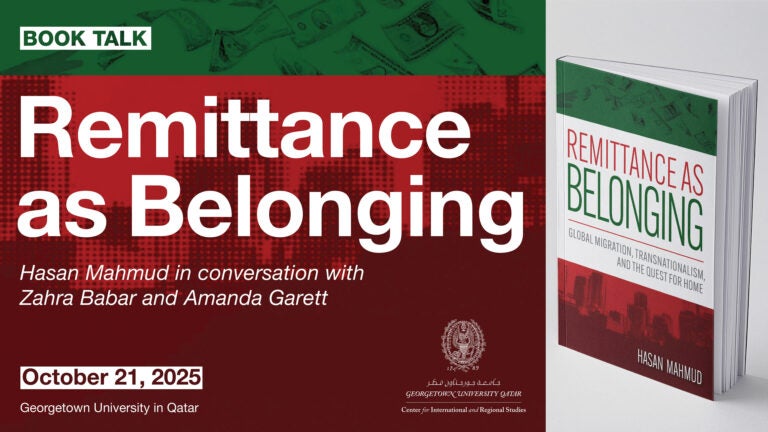
The Center for International and Regional Studies (CIRS) hosted a thought-provoking book talk with Professor Hasan Mahmud, author of Remittance as Belonging: Global Migration, Transnationalism, and the Quest for Home (Rutgers University Press). Moderated by Zahra Babar and Professor Amanda Garrett, the conversation delved into the moral, social, and emotional dimensions of remittances, reimagining them as acts of care, obligation, and identity that link migrants to their homes across borders. Drawing from ethnographic research with Bangladeshi migrants in Los Angeles and Tokyo, Professor Mahmud explored how remittance practices challenge conventional understandings of integration, citizenship, and belonging, revealing the deeply human stories behind economic exchange and migration.
Opening remarks introduced the book’s core proposition: remittances are not simply economic transfers. Rather, they are social acts grounded in obligation, care, and identity. The event also formed part of a broader CIRS research initiative on migration from the Global South. Drawing on three and a half years of ethnographic fieldwork with Bangladeshi migrants in Los Angeles and Tokyo, Professor Mahmud advanced a multidimensional conception of “home” as locational, relational, and aspirational. He showed how migrants enacted belonging across borders through financial support, investments, and gifts, and he challenged economic models that reduced remittances to altruism versus self interest. Instead, he located remitting in enduring social relationships and cultural expectations that shaped who sent money, to whom, and why.
Professor Mahmud contrasted incorporation contexts. In Japan, restrictive legal pathways and persistent social exclusion encouraged migrants to imagine their stays as temporary; remittances there tended to be frequent and oriented toward return, including investments in land and housing. In the United States, even with opportunities for settlement, citizenship, and family reunification, migrants continued to remit, although motives shifted over time: early transfers sustained relatives, later transfers helped restore status through property investments, and established professionals often turned to philanthropic giving in home communities. Across both sites, Bangladesh remained an anchor of belonging.
Audience questions highlighted the emotional labor that underwrote remittances on both sides of the border, including gendered obligations and intra family negotiations. Participants also raised the phenomenon of reverse remittances, when families in Bangladesh temporarily supported migrants during periods of precarity abroad. These dynamics complicated policy narratives that instrumentalized remittances as development finance and underscored the limitations of treating money in motion as a simple economic variable.
Article by Maryam Daud, Administrative Assistant at CIRS.
Speakers:
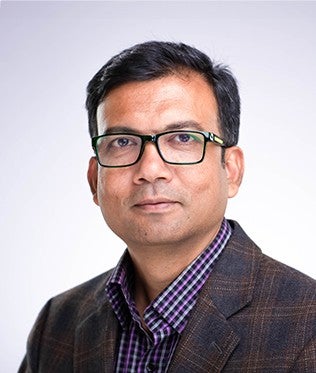
Hasan Mahmud is assistant professor in residence at Northwestern University in Qatar. He has a PhD in sociology from the University of California Los Angeles, an MA in global studies from Sophia University in Tokyo, and an MSS and a BSS in sociology from the University of Dhaka in Bangladesh. He was a visiting faculty member in the Department of Sociology at Ball State University prior to coming to NU-Q. His teaching and research interests include sociological theories, globalization, international migration and development, identity politics, and global ethnography. His research has appeared in such publications as Current Sociology, Migration & Development, Contemporary Justice Review, and Journal of Socio-economic Research and Development.

Amanda Garrett is Assistant Professor of Comparative and International Politics at Georgetown University in Qatar. Her research focuses on migration and ethnic diversity in advanced democracies, including immigration and integration, ethnic violence, minority political incorporation, and Islam in Western societies. Her current book project, developed from her Harvard PhD dissertation When Cities Fight Back, examines when religious or ethnic minorities use violence as political expression in France, the United Kingdom, the Netherlands, and the United States. She has held appointments at Harvard University, New York University, Sciences Po, and the German Bundestag, and received the 2014 APSA Ernst B. Haas Best Dissertation Award.

Zahra Babar is the Executive Director at CIRS at Georgetown University in Qatar. Previously, she has served with the International Labor Organization and the United Nations Development Program. Her current research interests include rural development, migration and labor policies, and citizenship in the Persian Gulf states.