Africana Studies Across Regions: In Conversation with Dr. Su’ad Abdul Khabeer and Professor Akintunde Akinade

In Conversation with Dr. Su’ad Abdul Khabeer and Professor Akintunde Akinade
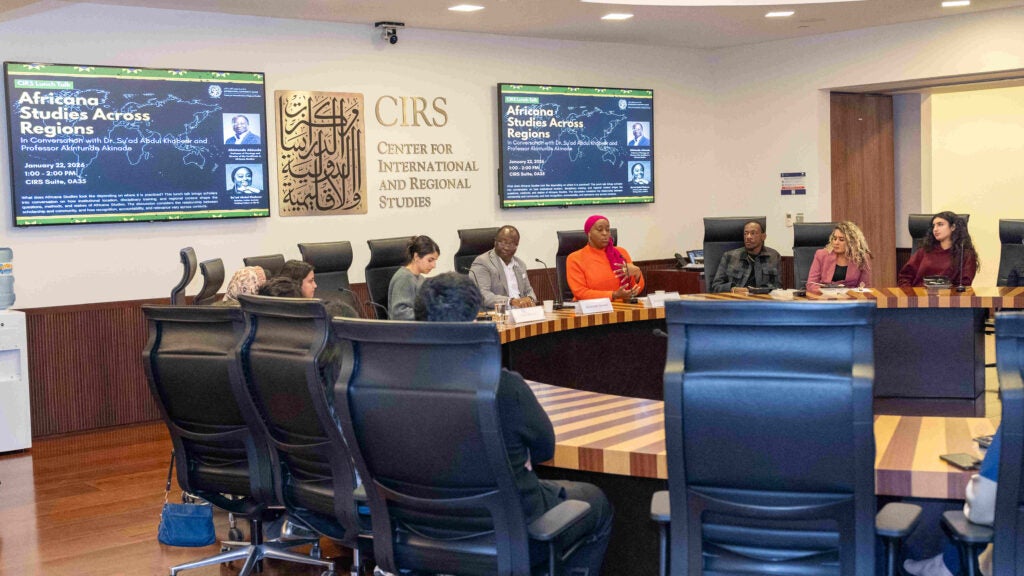
What does Africana Studies look like depending on where it is practiced? This lunch talk brings scholars into conversation on how institutional location, disciplinary training, and regional context shape the questions, methods, and stakes of Africana Studies. The discussion considers the relationship between scholarship and community, and how recognition, accountability, and relevance vary across contexts.
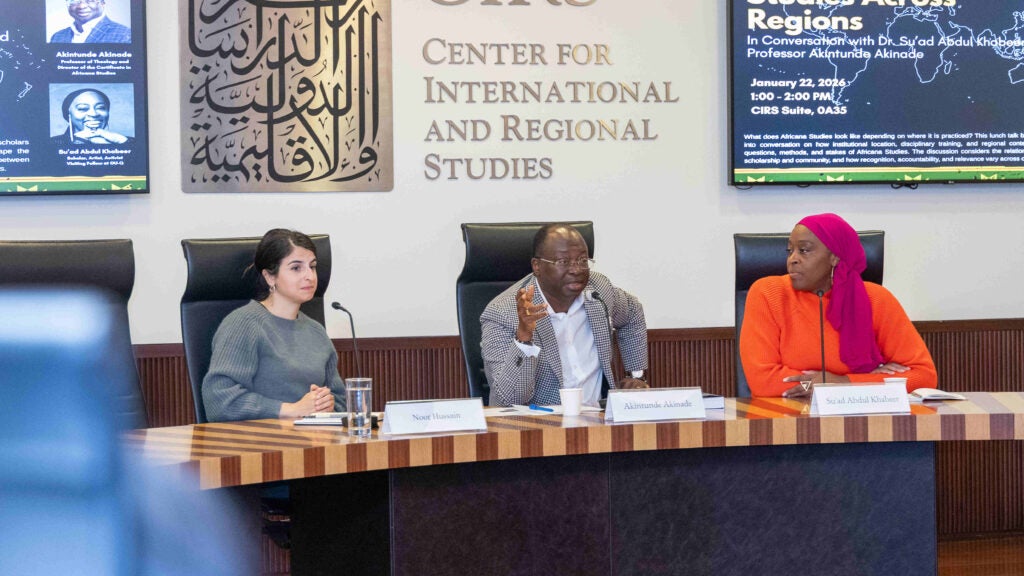
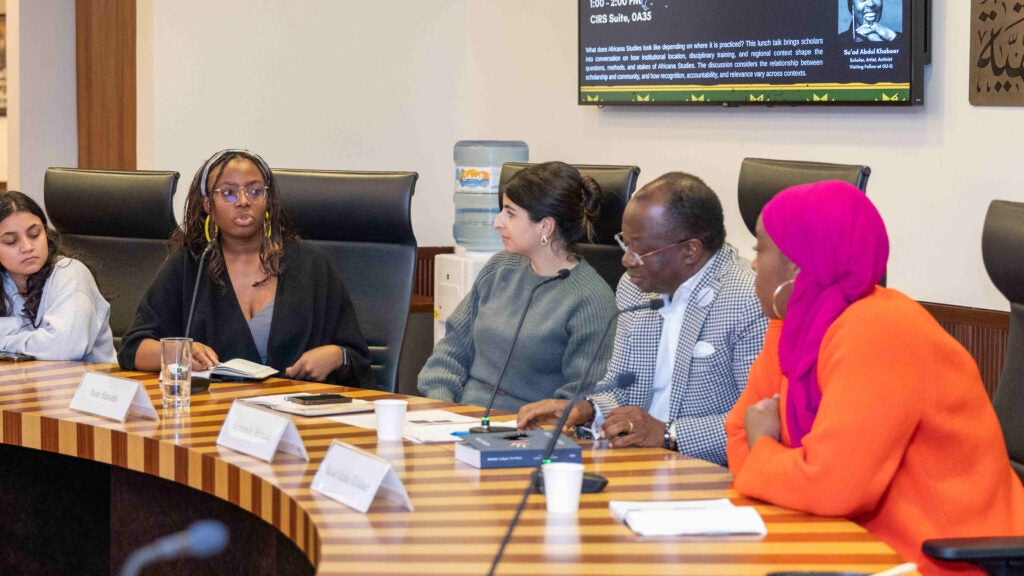
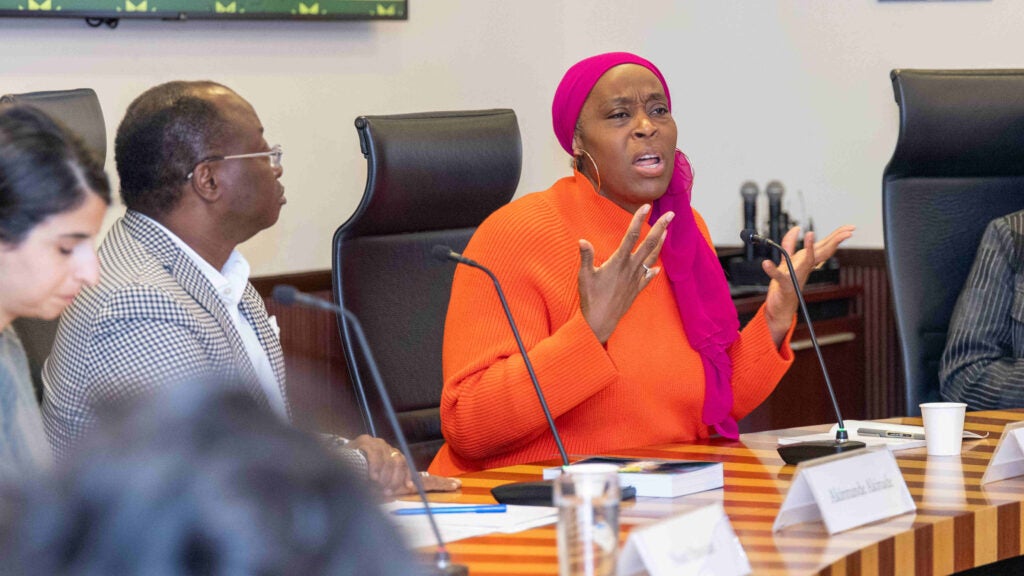
On January 22nd, the Center for International and Regional Studies (CIRS) hosted Dr. Su’ad Abdul Khabeer, a scholar of anthropology and Africana Studies at the University of Michigan, in conversation with Professor Akintunde Akinade, Professor of Theology at Georgetown University in Qatar. The dialogue explored the intersections of theology, Africana Studies, pedagogy, and resistance within increasingly hostile academic environments. The conversation began with both scholars reflecting on their experiences teaching liberation theology and Africana Studies, with Professor Akinade sharing that after nearly 30 years of teaching, he remains passionate about doing “theology for the people” and moving students beyond Eurocentric frameworks to engage with theologies from Latin America, Africa, and Asia. He described teaching a course on liberation theologies at GU-Q and noted that students are responsive and engaged, coming to class ready to move beyond dogma and think critically.
The discussion outlined the challenges of teaching in the current political climate, particularly around issues of white supremacy and institutional resistance. Professor Akinade shared a powerful teaching moment from his recent class where he defined white supremacy as sin, explaining that from a theological perspective, sin is separation—separation between humanity and divinity, but in the context of white supremacy, it manifests as separation between people through hierarchies that deny our shared humanity. Dr. Abdul Khabeer added Islamic theological perspectives on this, citing scholars like Sherman Jackson who frames white supremacy as shirk, the association of partners with God that destabilizes the fundamental Islamic principle of tawhid, the oneness of God. She also mentioned feminist Islamic theologian Amina Wadud who makes similar arguments about patriarchy usurping divine authority. Both scholars emphasized that these theological framings ground their resistance to oppression in core spiritual principles.
The conversation addressed how space and place shape what can be taught and said. Professor Akinade contrasted his experience teaching in Doha, where he feels freedom to speak openly, with his previous position in High Point, North Carolina, where students were more resistant to revolutionary content. Dr. Abdul Khabeer spoke candidly about the contemporary reality of teaching in the United States, including students recording classes to try to “catch” professors saying something controversial, the need to have attorneys on standby, meticulous documentation of all interactions, and the recent elimination of diversity, equity, and inclusion programming at the University of Michigan where she teaches. Despite these hostile conditions, both scholars emphasized the absolute necessity of continuing the work.
A significant portion of the discussion focused on teaching the humanity of Black people and moving beyond caricatures and stereotypes. Professor Akinade grounded this in the theological concept that everyone is created in the image of God, making every person precious and important with a divine spark. Dr. Abdul Khabeer described teaching a hip-hop course where she uses albums like Biggie Smalls’ “Ready to Die” to help students understand Black humanity in three dimensions rather than one-dimensional caricatures. She explained that by analyzing songs like “Suicidal Thoughts” and Geto Boys’ “Mind Playing Tricks on Me,” students learn to understand the socioeconomic contexts shaping people’s lives, recognize the community and relationships that exist, and see the solidarity and care present even in difficult circumstances. The goal is to move students beyond seeing Black people as hypersexual and hyperviolent stereotypes to understanding the fuller context of lived experiences, mental health struggles, and community support systems.
Both scholars emphasized the importance of embodiment and experience as forms of knowledge, challenging the Enlightenment paradigm’s overemphasis on reason alone. Dr. Abdul Khabeer, who is also a dancer trained in Katherine Dunham’s dance anthropology technique, explained how everyday life, how one dresses, moves through space, and physically exists, is deeply tied to history and politics. She shared an example of applying to Vassar College and discovering that the staircases were built for “women’s gaits” but her feet were too large for them, teaching her viscerally about who institutions are designed for and who they exclude. Professor Akinade connected this to his theological work, arguing that experience—particularly the experience of those raised in villages, those who have suffered, those marginalized—must be used to redefine orthodoxy and challenge monolithic paradigms. He referenced James Cone’s declaration that “God is Black” not as a statement about skin color but as an ontological connection with suffering, as Cornel West says, letting suffering speak.
The conversation highlighted the expansiveness that Africana Studies offers as an epistemology. Dr. Abdul Khabeer explained that unlike the traditional Euro-American tradition that says “you do it this way or that way and that’s it,” Africana Studies provides more options, more possibilities, and therefore more solutions. She attributed this expansiveness to the fact that Black people, particularly descendants of enslaved people, are “miracles walking” because they were not meant to survive but did survive through imagination and refusing to accept oppressive narratives as truth. This survival through creativity and alternative ways of knowing gives Africana Studies its power to envision futures and discover opportunities that dominant frameworks foreclose.
Professor Akinade challenged who gets to define rigorous scholarship, questioning why work not done at elite Western institutions like Rome, Columbia, or Yale is deemed less rigorous. He invoked Steve Biko’s book title “I Write What I Like” to assert his own approach: “I write what I like, I teach what I like, and I’m accountable, accountable to my people.” Both scholars emphasized that scholarship cannot be abstract but must be connected to life, must be life-giving, must help things grow. They discussed the danger of “dead scholarship” that exists only in ivory towers disconnected from the communities it purports to study, though Dr. Abdul Khabeer nuanced this by noting that death itself is a portal to other things in many traditions, so perhaps the better term is scholarship that is not life-giving, that doesn’t allow things to grow and flourish.
Article by Maryam Daud, Administrative Assistant at CIRS and Honore Mugiraneza, CIRS Publications Assistant