


CIRS Newswatch: Expert Insights
Bridging the gap between academic scholarship and public discourse, CIRS Newswatch is a dedicated platform on which GU-Q members contribute brief, expert reflections on significant current events as they unfold. The initiative recognizes the unique intellectual capital within GU-Q’s academic community and seeks to make that expertise accessible to a broader audience.
Issue 1: The Iran Conflict and Regional Implications
The inaugural edition of CIRS Newswatch centers on the ongoing war on Iran and its broader implications for the Middle East. Drawing on their areas of expertise, faculty contributors offer focused reflections on dimensions of the conflict that intersect with their scholarly disciplines, including international relations, political science, economics, energy, history, law, and regional studies. Contributions address political, humanitarian, economic, and security dimensions of the conflict, as well as its potential ripple effects across neighboring states and the broader Gulf region.
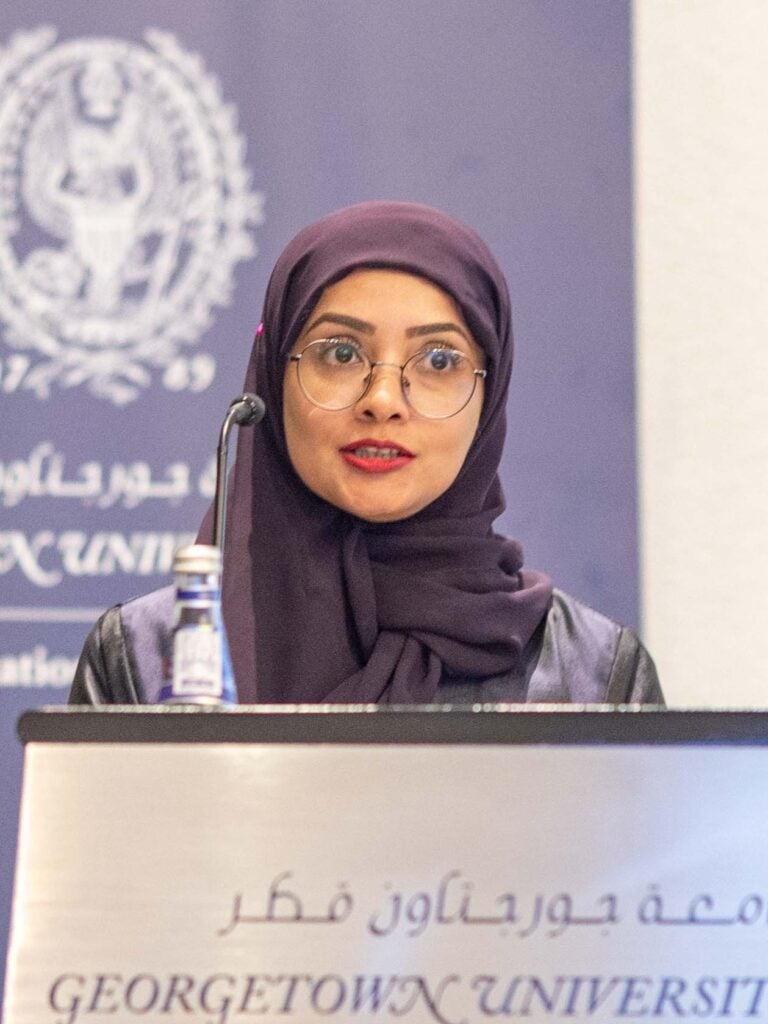
6. Pakistan’s Strategic Calculus: Why Islamabad Hosted the US–Iran Peace Talks, April 2026
Misba Bhatti, Research Analyst at CIRS, GUQ
Pakistan’s role as a mediator in the 2026 Iran-US/Israel war is not an act of altruism; it is a calculated exercise in strategic self-preservation. As experts have highlighted, there are very few countries that have diplomatic standing that is accepted by both Washington and Tehran to serve as a credible mediator. Pakistan, it seems, is one of them.
Pakistan’s motivations are empirically grounded. Its border with Iran stretches nearly 1,000 km, meaning a full-scale Iran-US/Israel war would directly destabilize Pakistan’s western frontier. Economically, Pakistan is heavily dependent on Middle Eastern oil imports, and disruption to the Strait of Hormuz poses a direct threat to its energy lifeline. Approximately five million Pakistani citizens work in the Gulf region, with remittances forming a vital pillar of foreign exchange earnings. With more than 85% of Pakistan’s oil needs supplied by Saudi Arabia, Qatar, and neighboring Gulf states, Islamabad had to act.
The strategic gains, however, extend well beyond damage control. In early 2026, Pakistan joined the Board of Peace, a global body created by Trump, deepening Washington’s trust in Pakistani leadership. A tripartite quasi-alliance has also emerged between the US, Saudi Arabia, and Pakistan, underpinned by a Strategic Defense Agreement signed in September 2025. On the economic front, Saudi Arabia provided $3 billion in additional support to Pakistan in April 2026 and extended a $5 billion facility rollover for three more years.
Pakistan’s role as mediator also carries historical precedent. Just as Pakistan facilitated Henry Kissinger’s 1971 visit to Beijing at the height of the Cold War, breaking 22 years of frozen Sino-US relations, it now positions itself once again as a “middleman” in a defining reconfiguration of the global order.
There is also a domestic political calculus that cannot be ignored. The Sharif government has operated under severe economic strain, with Pakistan’s annual inflation climbing to 7.3% in March 2026, its highest since August 2024, and petrol prices surging by Rs. 55 ($0.20) per liter in a single month, triggering long queues at fuel stations and widespread public frustration. The Iran-US/Israel war directly worsened this picture: rising global oil benchmarks, the closure of the Strait of Hormuz, and rupee depreciation combined to produce what analysts have described as a “petrol shock,” with fuel costs at the pump reaching Rs. 458 per ($1.64) liter by April 2026.
In order to deal with the effects of this petrol shock, Prime Minister Shehbaz Sharif announced emergency energy-saving measures, including a four-day work week and school closures, underscoring just how acute the domestic pressure had become. Amid mounting tensions, anti-American protests erupted across Pakistan’s major cities following U.S. strikes on Iran and the killing of Supreme Leader Ali Khamenei, which left at least 22 people dead and more than 120 injured nationwide. Against this backdrop, Pakistan’s mediation role offered the government something rare and valuable: a foreign-policy narrative capable of transcending domestic grievances. By positioning itself as the broker of a global ceasefire, the Sharif administration could present itself not as the author of economic hardship, but as its solution, a government actively working to end a war that is driving up fuel and food prices.
Pakistan’s mediation carries both economic wins for the country, cheaper energy and re-established energy trade disrupted by the Strait of Hormuz closure, and strategic benefits, including potential investment and a strengthened regional role. For a country long overshadowed by India’s economic rise, the Islamabad mediation talks represent a rare opportunity to reassert geopolitical relevance. The question is whether Pakistan can convert a reputational win into durable structural gains before the ceasefire expires and the window closes.

7. Europe’s Embarrassing Reckoning, May 2026
Gábor Scheiring, Assistant Professor of Comparative Politics at GUQ
Two months into the war on Iran, the skeptics have been vindicated, and Europe’s center is slowly rediscovering the international law it abandoned in February.
Liberal globalism has collapsed; violent, lawless illiberalism epitomized by Trumpism fills the void. The European center, with Merz as its figurehead, was meant to be the counterweight. Instead, when the US and Israel struck Iran on February 28, German chancellor Merz refused to “lecture” allies, declared international law inapplicable, and, in June 2025, described Israel’s strikes as Europe’s “dirty work.” This subservience has cost Europe enormous political capital globally.
Strikes do not produce stable orders. They produce destroyed infrastructure, civilian casualties—like the strike on a girls’ school in Minab that killed 160 children—and the siege narrative the regime needs to suppress dissent. The protests that shook Iran in late 2025 were the organic material from which transformation is built. That material is now buried under rubble.
Sixty days of bombing later, the German chancellor has discovered nuance, conceding that Washington went in without a strategy and is “being humiliated by the Iranian leadership.” Welcome, Herr Bundeskanzler. The Norwegians and the Spaniards have been holding your seat. Jonas Gahr Støre declared the strikes incompatible with international law from day one, and Pedro Sánchez closed Spanish airspace to American aircraft. The European Parliament’s S&D Group backed him.
In April, Spain, Slovenia, and Ireland pushed to suspend the EU-Israel Association Agreement; a Citizens’ Initiative gathered over a million signatures. Germany and Italy blocked the move, but Europe is changing. The center of gravity is moving away from the civilizationist scaffolding that made the bombing seem righteous, and from the impunity that protected Israel from consequences.
International law is either applied to all or it protects none; the world is waiting to see if Europe finally understands this.

8. The Wars We Will Inherit, May 2026
Zarqa Parvez, Post-Doctoral Fellow at GUQ
We are comfortable analyzing what this war is doing to alliances, energy markets, and the regional security architecture. We are far less honest about what it is doing to social identity in the region and across the world—and why that matters as much as any ceasefire agreement.
This conflict has rewritten the rules of modern warfare in real time. It is a war fought as much through public perception, narrative, disinformation, and psychological operations as it is through missiles. AI-generated footage of strikes circulated faster than verified reports could correct them; chaos stopped being a condition of war and became its strategy. Economic coercion—sanctions, energy leverage, financial pressure—has replaced the battlefield as the primary arena of attrition. The architecture of conflict has fundamentally changed.
But here is the argument we are hardly discussing.
Historically, ethnoreligious and sociopolitical identities are fluid. They shift, merge, and dissolve across generations. They are weaponized in times of threat—that much is familiar. What is categorically different about this war is that it is not merely exploiting identity; it is being fought through and for identity. Sectarian divisions in the Middle East—civilizational, religious, and ethnic—are not the propaganda layer on top of a geopolitical conflict; they are its ideological engine, source of legitimacy, and mechanism of mass mobilization.
That is what makes this war unprecedented in reach. It has conscripted people far beyond the warzone—student mobilizations on Western university campuses, protest movements across the globe, and online engagement—transforming bystanders into active political actors. The us versus them logic—the West and Israel against Iran and the resistance axis, but also, increasingly, among Middle Eastern societies themselves—has hardened existing sectarian fault lines in and manufactured new alliance solidarities across communities that previously had little common cause.
Conflicts end. The sectarian, religious, and civilizational identities this war has activated, weaponized, and legitimized will remain. That is the reckoning for which the post-war world is entirely unprepared.

9.What is the Impact of the Iran War on Energy Markets (Including Renewables)?, May 2026
Gani Aldashev, Professor at GUQ
The war has brought three supply-side shocks to the world’s oil and gas markets: first, damage to oil and gas infrastructure in the Gulf; second, the closure of the Strait of Hormuz, through which 20–25% of global oil supply and 20% of Liquefied Natural Gas (LNG) transit; and third, increased uncertainty about the stability of oil and gas supplies.
These shocks have led to a substantial contraction of supply in the short run. This, combined with the fact that the demand for oil and gas in the short run is very inelastic—in other words, there are no good or immediate substitutes for a drop in supply of these sources of energy—has led to a huge increase in global prices of oil and gas. As time passes, demand is likely to react: people in the regions most affected by a drop in the supply of Gulf oil and gas, mostly Asian countries, will postpone or cancel non-essential travel, switch to local tourism, use public transportation instead of private cars, etc. This will partly attenuate the effect on price, but only to a limited extent.
Another response (mostly to the uncertainty shock) will be a turn to other sources of energy: coal, nuclear, and renewables. This will have mixed results, as coal is much more polluting than, for instance, LNG, but, on the other hand, the switch to renewables—the “green transition”—which had slowed down in the last few years due to various economic and political reasons, is likely to accelerate.
Behind the aggregate effects are huge differences in the distributive impact of these shocks. While non-Gulf producers of oil and gas (for example, firms in the U.S. and Russia) get a windfall gain from the jump in prices, the negative effects fall on consumers (including in the U.S.) and firms, such as airlines, that rely entirely on oil and gas energy inputs.
The opinions expressed in these articles are those of the author and do not necessarily reflect the views of the Center for International and Regional Studies.
More from GU-Q experts
Diana Buttu, Practitioner in Residence at GUQ
Since the beginning of the Zionist project, Israel has long had the goal of expanding the territory it controls. This is why one can see that, with the Partition Plan of 1947, Zionist attacks were not confined to the areas illegally “allocated” to the “Jewish state” but were aimed outwards. This is also why Israel made a “pre-emptive” (i.e. illegal) attack against Syria, Egypt, and Jordan in 1967, and continues to illegally occupy and colonize the West Bank, the Gaza Strip, and the Golan Heights in violation of international law and of international decisions.
More recently, Israeli leaders have made it no secret that they intend to annex the West Bank, recolonize the Gaza Strip, and take land from Lebanon and Syria. Under the guise of perpetual war, this is precisely what Israel has done: it has gone deep into Lebanon, using the same tactics that it used in Gaza; Israeli settlers have continued their takeover of Palestinian lands in the West Bank; and the Israeli army remains in Syria and in Gaza, with Israeli attacks on Gaza continuing daily.
Speaking on the second day of the US/Israel attack on Iran, Israeli Prime Minister Netanyahu said that he had “yearned” for this strike for 40 years, evoking Biblical references comparing Israel to Samson. Once this war is over—if at all, for I see that Israel has normalized the bombing of Iran, Lebanon, and Gaza, and the assassination of their leaders—the question the world will need to confront is whether Israel operates above the system of law and order that was put into place after the Second World War or whether the rules are simply not applicable. In other words, will Lebanon and Palestine be forced to “negotiate” a return of their lands? Will Iran be forced to “negotiate” an end to an illegal bombing campaign? Or, will we see a system that finally confronts the country that has made a mockery of the international legal system?
Noha Aboueldahab, Assistant Professor of International Law at GUQ

Many international lawyers are clear on the illegality of the U.S.-Israeli war on Iran, launched on the 28th February 2026. The main reasons: the absence of a UN Security Council resolution authorizing such use of force, and the absence of any credible U.S./Israeli claims of the right to self-defense. Gulf states, including Qatar, were deeply engaged in mediation efforts between the U.S. and Iran at the time of the start of the war. The U.S. and Israeli unlawful use of force against Iran resembles Israel’s illegal attack on Qatar’s mediation efforts between Hamas and Israel, when it launched missiles at negotiators on Qatar’s territory in September 2025.
The U.S. has not been silent on international law – quite the opposite. Shortly before the war, Trump stated that he is guided by his “own morality” and that he does not “need international law”. Pete Hegseth made his thoughts on international law equally clear during the war: “No stupid rules of engagement…no politically correct wars.”When the U.S. sank Iranian ships rather than capture them in accordance with international law, Trump explained that “his people” told him “it’s more fun to sink them.”
In the nearly two months of this war, several other international law-related concerns have emerged, implicating and/or affecting not just the main parties to the conflict (Iran, Israel, the U.S.), but also regional (Gulf) states, Lebanon, and the U.K. These include violations of the laws of war, including war crimes, and state complicity in acts of aggression, as outlined in Article 16 of the Draft Articles on State Responsibility, ‘Aid or assistance in the commission of an internationally wrongful act.” Iran’s retaliatory attacks that target civilian infrastructures are also unlawful. As some international lawyers note, the U.S. and Israel can end Iran’s unlawful retaliations by ending this illegal war of aggression.
Paul Musgrave, Associate Professor of Government at GUQ
Iran’s expansion of its war with Israel and the United States has been waged largely by what was once called “push-button” means. Rather than soldiers launching assaults or pilots dueling in the skies, Iran has relied on ballistic missiles, cruise missiles, and one-way attack drones. Countries such as Qatar have shown their own technical prowess, using anti-drone and anti-missile defenses to blunt these attacks.
The recent weeks also hint at what future Gulf conflicts might look like. Sophisticated defenses against precision-guided attacks have proven their value, but aggressors are learning too. A future conflict could feature attacks by larger swarms of more agile drones and varied warheads on ballistic missiles—including cluster munitions that force defenders to choose between draining their magazines or accepting dispersed harm.
Defenses will have to adapt, combining exquisite, high-end systems with cheaper counter-UAV layers. Contrary to some Western commentary, Qatar has not been shooting down $10,000 drones with multimillion-dollar interceptors—but more sustainable defenses against lower-end threats can and should be developed. Efforts along these lines are reportedly already underway.As anti-air missile ranges expand to several hundred kilometers, Gulf countries may face a lack of permissive airspace even over their own territory. The expansion of the front lines to the skies over Doha and Dubai would place a premium on defensive swarms, electronic warfare, and long-range counter-battery fires, potentially using systems like the US Army’s PRSM or South Korea’s Hyunmoo. These capabilities are costly, but the wealthier, better-equipped side retains meaningful advantages—ones the GCC is positioned to exploit. In any event, it is costlier to be on the weaker side.
Most important is the development of stronger maritime defenses. The conflict has underscored the importance of the Strait of Hormuz and the difficulty of reopening it once closed. Given the global importance of the strait, no single country should bear the burden of defending it alone. Yet it is also clear that the GCC and Iraq have a particular interest in shielding their commerce from hostilities. A capable multinational naval and aerospace force would blunt any aggressor’s ability to hold the global economy hostage and preserve the sovereignty of GCC countries.
Abdullah Al-Arian, Associate Professor of History at GUQ
Hopes were high on April 8, 2026, when Donald Trump announced a “double-sided ceasefire” to halt a war that had taken thousands of lives, left West Asia in flames, and sent shockwaves through the global economy. Hours after warning that “a whole civilization will die tonight,” Trump called Iran’s proposal a “workable basis” for negotiations. Yet, within twenty-four hours, the talks in Pakistan collapsed, with JD Vance blaming Iran’s refusal to accept U.S. terms.
While the abrupt breakdown surprised many observers, it was consistent with a broader trajectory in recent U.S. diplomacy. Since unilaterally withdrawing from the 2015 nuclear agreement (JCPOA), Washington has faced a persistent credibility deficit in its engagements with Tehran. More significantly, diplomacy has increasingly functioned as an extension of warmaking. Twice in the last year, negotiations have served as cover for escalatory military actions.
This pattern was evident in the latest round of talks. Despite initial signals of flexibility, U.S. negotiators returned to the same maximalist objectives articulated prior to the conflict. The preceding thirty-nine day military campaign failed to achieve its core aims, whether constraining uranium enrichment or eliminating Iran’s missile production capabilities, yet these goals were carried forward largely unchanged. The implicit assumption appeared to be that diplomacy could deliver what military force had failed to secure.
Personnel choices further underscore this approach. Rather than relying on the institutional diplomatic corps, the Trump administration has elevated political allies such as Steve Witkoff and Jared Kushner, whose roles blur the line between diplomacy and political alignment. Voices in Washington and across the region have noted that both are widely perceived as “Israeli assets”—an assessment that helps explain the expansion of U.S. demands beyond earlier negotiating positions and toward alignment with Israeli strategic priorities.
In this context, the failure of the April 2026 ceasefire talks was less a diplomatic misstep than a predictable outcome. It reflected a framework in which diplomacy is not designed to resolve conflict, but to continue it by other means. Though it was only the first round of talks, Vance stated flatly that the U.S. had offered its “best and final offer.” Notwithstanding Iran’s declared desire for a permanent deal, based on recent Israeli and American practice, any agreement will likely be considered temporary, granting the U.S. the ability to achieve immediate aims such as restoring access to the Strait of Hormuz, while retaining the ability to resume military action at any time.
Looking ahead, the more consequential question may not be whether an agreement is ultimately reached, but whether it can be enforced. While reopening the Strait of Hormuz remains a clear U.S. priority, recent regional developments raise doubts about durability. Constant Israeli violations of ceasefires in Gaza and Lebanon, coupled with the absence of meaningful enforcement mechanisms, underscore the limits of agreements that rely on political will alone. The genocide in Gaza has laid bare the paralysis that now defines the international legal order and its governing institutions.
Mehran Kamrava, Professor of Government at GUQ

The shape of the security arrangement at the end of the Israeli-American war on Iran is yet to be determined. But a few facts are already evident. To start, the United States is far more concerned with Israel’s security than it is in providing protection to its allies in the Persian Gulf. As Trump’s repeated posts on social media indicate, he is willing to commit genocide and other war crimes to achieve his goals if conventional warfare does not yield the results he wants. On the Iranian side, the Islamic Republic is the only country to have withstood military attacks by two nuclear powers and to have fought them into a stalemate. Tehran sees this as a major victory. Iran also has the capability and, more importantly, the willingness to attack military and industrial targets across the Gulf region regardless of the diplomatic costs it suffers in the process. And the so-called Axis of Resistance, especially insofar as the Lebanese Hezbollah, the Houthis, and Iran’s Iraqi proxies are concerned, is not as dead and irrelevant as it was assumed to be before the war. Combined with other considerations, these factors are likely to have several consequences in the coming months and years. Clearly, the GCC is likely to diversify its existing security partnership. Also, as the Qatari government has already indicated, Iran cannot be ignored or simply wished away. The recent war will push the regional arms race to new heights, as countries like Saudi Arabia and the UAE will do what they can to match and surpass Iran’s missile capabilities. There will also be greater emphasis on domestic arms production in Saudi Arabia, the UAE, and Qatar. At the same time, both individually and collectively, the GCC states are likely to continue, or to reestablish, their diplomatic relationships with Iran. All things considered, the regional security arrangement in the Persian Gulf is likely to be very different from the one we have come to know over the course of the last few years.