


Rethinking Migration Categories from the Global South Workshop II (Virtual)
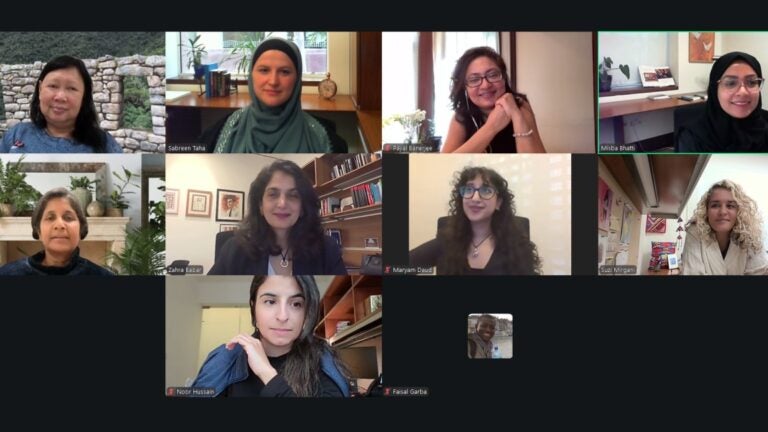
On August 24–25, 2026, the Center for International and Regional Studies (CIRS) at Georgetown University Qatar hosted the second workshop under its research initiative, Rethinking Migration Categories from the Global South. Held virtually, the workshop centered on draft papers submitted by project participants, with the goal of offering in-depth, constructive feedback to strengthen each contribution.
The workshop commenced with a presentation by Zahra Babar, with a paper titled, What the Gulf Reveals About Liberal and Illiberal Governance of Migration. In her study, she examines Gulf migration governance, especially the understudied “Azad” visa, to challenge the dominant assumption that migrant precarity stems primarily from regime type, i.e., that authoritarian “illiberal” states produce exploitative migration systems while liberal democracies offer inclusion and eventual citizenship. Babar’s central research question does not ask whether migration governance is liberal or illiberal, but how all states, regardless of regime type, reconcile dependence on migrant labor with efforts to limit political membership. Using the Gulf as a theory-generating case, she argues that legal ambiguity, labor flexibility, and differentiated status are not exceptional to Gulf authoritarianism but reflect broader global patterns of managed mobility. The Azad visa illustrates governed informality, a state-produced arrangement. Reform should not assume that citizenship is a migrant’s ultimate goal; instead, it calls for rethinking long-term temporary migration through security, autonomy, and mobility rather than liberal-democratic convergence.
In the next session, Faisal Garba Muhammed’s paper, African Migration and Theory: Critique and Alternatives, critiqued dominant migration theories—neoclassical, dual labor market, world systems, and network-based approaches—as products of Western migration contexts. These are poorly suited to Africa, where data is forced into finished theories rather than theory built from African realities. His central argument is that existing frameworks miss African notions of territoriality, fluid identity, and belonging, which historically were shaped by pre-colonial mobility, resistance to authoritarian rulers, and multiple simultaneous political memberships later disrupted by colonial fixation of ethnic homelands. Drawing on Rodney’s dependency framework, Muhammed argues that migration studies remains structured by global knowledge inequality, with Northern institutions setting research agendas around migrant “crises” rather than African realities or South-South mobility. His work also incorporates feminist critiques, showing how structural adjustment programs and mainstream development theory obscure gendered and collective dimensions of mobility. Overall, Muhammed calls for decolonizing migration theory by centering African epistemologies, historical specificity, and collective/feminist conceptions of movement over inherited Northern models.
Aashish Karn’s paper, Migrant Ecosystems: Identity, Place-making, and Agency among Nepalese Migrants in Doha, then examined Gulf migration. He introduced migrant ecosystems as interconnected social, economic, and symbolic worlds that migrants produce through everyday practice, as an alternative to suffering-centered analyses that emphasize only exploitation and legal exclusion. Drawing on ethnographic fieldwork among Nepalese migrants in Doha (2022–2023, 2026), Karn asks whether the categories used to govern and study migration, mainly nationality, match the distinctions migrants themselves actually maintain in daily life. The paper argues they do not: among Nepalese migrants, everyday association is organized not by nationality but by the Pahadi-Madhesi ethnic-regional divide, a boundary migrants construct and sustain themselves. This work examines this phenomenon through three interlocking processes—identity/belonging, place-making, and agency—which emerge through proximity and interaction rather than separation, and are internally stratified rather than communal. The broader aim of the paper is a conceptual reorientation: treating Gulf migrants as social actors actively producing meaning and hierarchy, rather than reducing them to legal precarity alone.
Brenda Yeoh, Madeleine Shutler and Theodora Lam’s paper, The Developmental Migration State and its “Categorise-and-Control” Strategies: The Case of Singapore,examinesSingapore as a case of the “developmental migration state,” where migration policy prioritizes national economic development, demographic renewal, and social stability over rights-based liberal norms. The paper questions how developmental states use categorization itself as a governance technology to control migrant populations without extending settlement or citizenship. The authors argue that Singapore’s elaborate, multi-tiered system—i.e., sorting migrants by skill, salary, nationality, and occupation—exemplifies Foucauldian “categorical control,” dividing, ranking, and disciplining migrant groups according to their perceived economic utility. Unlike East Asian counterparts, such as Japan and Taiwan, that have begun loosening pathways to permanent residency, Singapore maintains strict, racially calibrated boundaries between citizens and non-citizens via its Chinese-Malay-Indian-Others (CMIO) framework. The paper identifies four specific strategies of categorical control: skill hierarchization, graduated temporariness, controlled category conversion, and the narrowing of legal “grey zones,” positioning Singapore as a paradigmatic case of developmentalist migration governance.
In the last session, Payal Banerjee’s paper, Assembling Documented Status: Visas, Flexible Labor, and the Legal Ecosystems of Status and Rights Retrenchments, examines Indian IT workers on H-1B visas in the US. She challenges the assumption that “documented status” is simply a fixed legal fact tied to holding a valid visa. Banerjee’s research asks how documented status actually gets constructed in migrants’ lived experience, beyond immigration law. She argues that status is assembled through the interaction of visa rules with flexible labor regimes—i.e., subcontracting, employer-dependence, “bench” periods, and legal ecosystems, like judicial retrenchment and mandatory arbitration systems, are technically outside immigration policy and yet are decisive in shaping migrants’ vulnerability. Drawing on 25 years of interviews, Banerjee shows how H-1B visa holders, despite formal labor protections, face employer coercion, wage manipulation, housing instability, and blocked access to courts, with caste and gender compounding these precarities. The paper highlights that documented status is a political-economic and legal construction, not an obvious given, and calls for analyzing migrant status through lived, contextual experience rather than binary legal categories.
CIRS aims to publish this collection of papers as a special issue of a journal.
- To view the working group agenda, click here
- To read the participants’ biographies, click here
- Read more about this research initiative
Participants and Discussants:
- Zahra Babar
- Payal Banerjee
- Misba Bhatti
- Maryam Daud
- Bina Fernandez
- Faisal Garba
- Noor Hussain
- Aashish Karn
- Suzi Mirgani
- Sabreen Taha
- Brenda S.A. Yeoh FBA