


Reconfiguration of GCC (In)Security Dynamics
Reconfiguration of GCC (In)Security Dynamics
This research project aims to examine the ongoing transformations of the Gulf Cooperation Council (GCC) security architecture amid shifting global power dynamics, focusing on the interplay between strategic defense partnerships, evolving great power relationships, and developing indigenous military-industrial developments. The initiative will examine how the GCC states are balancing their reliance on traditional security guarantors and emerging partners while simultaneously developing domestic defense capabilities through joint ventures and strategic industrial partnerships.
Background
The present moment represents a critical juncture for understanding the GCC security dynamics. Several converging developments make this research both timely and essential. On 28 February 2026, the United States (US) and Israel launched coordinated military strikes against Iran under Operation Epic Fury, targeting military infrastructure, government ministries, and nuclear sites across multiple Iranian cities. Iranian Supreme Leader Ayatollah Ali Khamenei was killed along with senior military commanders, leaving Iran under an interim three-person leadership council. The strikes were framed as a response to Iran’s continued non-compliance following Operation Midnight Hammer in June 2025, which had previously targeted Iranian nuclear facilities. The conflict had been building for months, with massive anti-regime protests erupting across Iran in late December 2025 amid economic collapse, met with violent IRGC crackdowns, while US President Trump issued escalating public warnings to Tehran throughout January and February 2026.
Iran retaliated swiftly and broadly, launching simultaneous ballistic missile and drone attacks against the GCC states hosting US military infrastructure, Bahrain, Kuwait, Qatar, the UAE, Oman and Saudi Arabia, as well as Jordan and Iraq. The UAE suffered the most extensive strikes, with 137 missiles and 209 drones launched on 28 February alone, causing fires at Dubai’s Palm Jumeirah, striking Dubai International Airport, and killing at least one person at Abu Dhabi’s airport. Qatar, struck for the third time in less than a year, intercepted most incoming munitions, but its power plant in Meiseed and an energy facility in Ras Laffan, along with the US base in the country, were targeted. Bahrain’s US Navy 5th Fleet headquarters was targeted, including a Shahed-136 drone strike on a radar installation at Naval Support Activity Bahrain. Kuwait’s Ali al-Salem Air Base was hit, and Saudi Arabia’s Eastern Region, Riyadh, and an Aramco oil refinery in Ras Tanura were also struck. Oman, a traditional intermediary with Iran, was also targeted at its Duqm port, and an oil tanker in the Strait of Hormuz came under fire. By 5 March, open-source intelligence tracking indicated that Iran had launched roughly 585 ballistic missiles and over 1,500 drones since the opening of the campaign, with the UAE and Kuwait absorbing the heaviest salvos among GCC states.
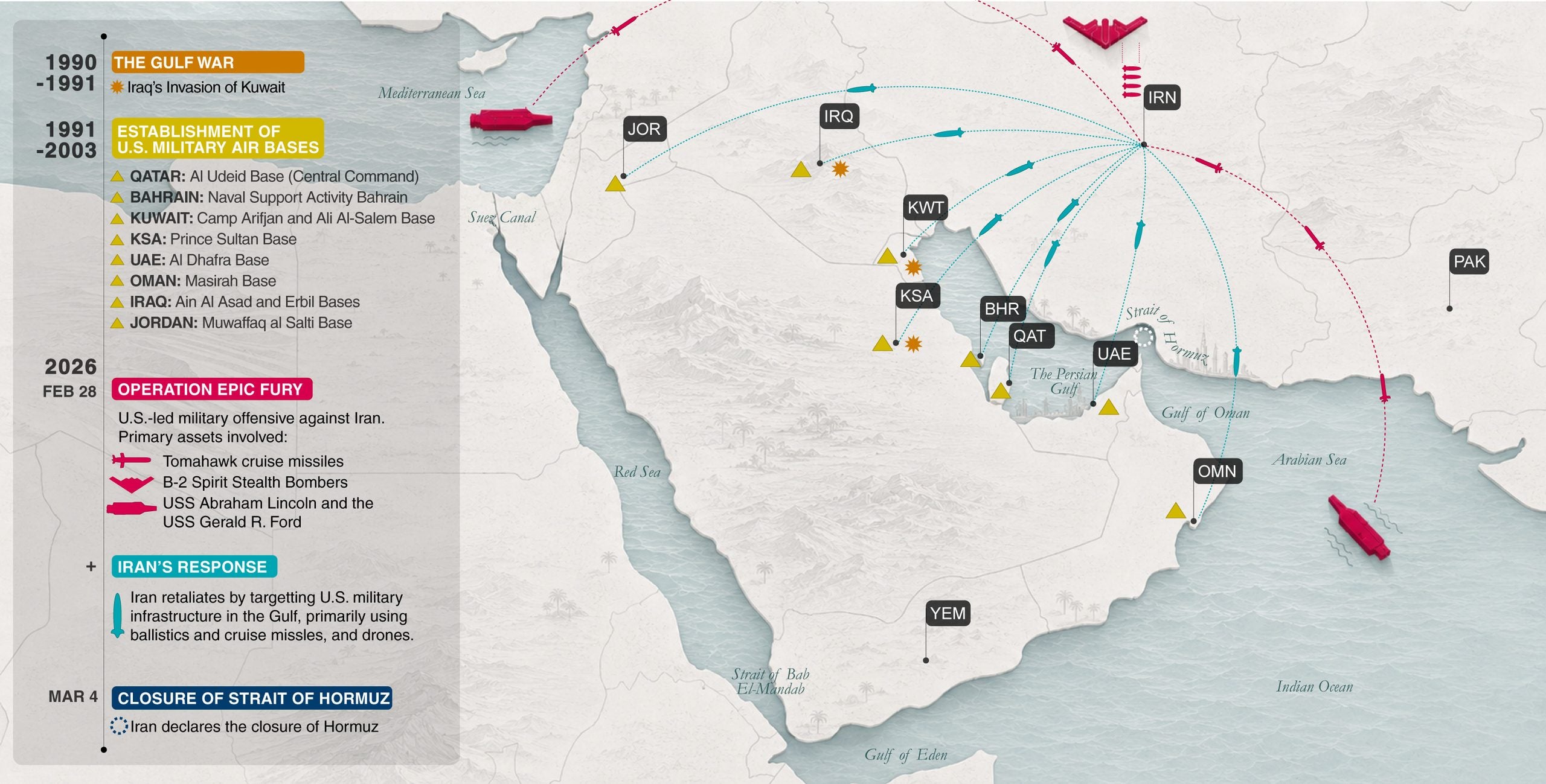
Disclaimer: This map is not an exhaustive representation of all events associated with the conflict. It highlights selected incidents and locations for illustrative purposes. Coordinates are approximate and should be understood as indicative rather than exact. Countries represented: QAT (Qatar), BHR (Bahrain), JOR (Jordan), IRQ (Iraq), IRN (Iran), KSA (Saudi Arabia), UAE (United Arab Emirates), OMN (Oman), YEM (Yemen), PAK (Pakistan).
The launch of Operation Epic Fury on 28 February 2026 represents the most consequential single event for the GCC security architecture since the 1991 Gulf War. The conflict has served as a stress test of every dimension of the GCC security that this research project aims to examine: the reliability of the US as a security guarantor, the adequacy of indigenous and collective air and missile defense, the vulnerability of critical energy infrastructure, the hybrid cyber-kinetic threat environment, and the strategic implications of the GCC military-industrial dependencies.
The ongoing regional tensions have fundamentally altered regional threat perceptions. Simultaneously, the changing of Iranian regional power following the February 2026 attacks and degradation of its proxy networks, combined with heightened security concerns in the Levant and Yemen, and the friction between Saudi Arabia and the UAE, has created a window for structural security realignment. The Trump administration’s executive order, deemed necessary to finalize a Gaza ceasefire, declaring attacks on Qatar a threat to US security, represents the establishment of a potential new paradigm for regional security commitments.
This research builds on previous CIRS work on regional security dynamics and aims to contribute theoretically to understanding security transitions in multipolar environments, empirically to mapping the GCC military-industrial development trajectories, and practically to informing policy debates regarding sustainable security architectures in strategically vital regions.
The project aims to explore topics across the following themes:
The maturation of the GCC defense industrialization efforts, particularly the UAE’s EDGE Group, which generated $4.9 billion in contracts in 2024, and Saudi Arabia’s commitment to 50% defense procurement localization by 2030, signals a fundamental shift from import-dependent security models to technology-enabled strategic autonomy. This study aims to examine how the GCC states navigate between seeking strategic autonomy through defense industrialization and managing persistent dependencies on external partners. This analysis incorporates concepts of hedging behavior, whereby the GCC capitals maintain multiple security relationships simultaneously to maximize flexibility and minimize vulnerability to any single guarantor’s potential withdrawal.
The defense sectors in the GCC are transforming from procurement-dependent models to production-oriented ecosystems. Examples of this institutional architecture are Qatar’s Industrial Group, UAE’s EDGE Group, and Saudi Arabia’s SAMI, which integrate foreign technology transfer, indigenous innovation, and export-oriented production. The study aims to evaluate whether the GCC military-industrial development represents genuine technological autonomy or constitutes strategic bargaining leverage within continuing dependency relationships. Scholars that study these institutions have highlighted the gap between localization targets and implementation realities. While Saudi Arabia aimed to raise defense localization from 4% in 2018 to 50% by 2030, current achievement stands at approximately 20%, with senior leadership reshuffles in 2025 exposing tensions between vision and delivery. The research aims to explore structural constraints, including skilled labor shortages, limited research and development absorption capacity, and reliance on imported subsystems that fundamentally limit autonomy aspirations.
Operation Epic Fury has sharpened the policy debate around the GCC defense industrialization in ways that this research must address. The conflict has exposed acute vulnerabilities in the GCC air and missile defense architecture that existing procurement arrangements cannot quickly remedy. The depletion of US precision munitions inventories at rates that significantly outpace production and strain US munitions stockpiles, raises urgent questions about the reliability of US extended deterrence during a sustained high-intensity conflict. This constraint directly incentivizes the GCC states to accelerate indigenous munitions production and missile defense acquisition, even if immediate results are limited by the structural constraints already identified in the project design.
The conflict has simultaneously validated the GCC investment in integrated air defense systems and revealed gaps that must be addressed. GCC states’ THAAD deployments and Patriot batteries performed significantly in intercepting Iranian ballistic missiles, but the sheer volume and simultaneity of Iranian strikes, over 350 missiles per day in the opening phase, demonstrated that no air defense architecture can provide absolute protection against saturation attacks. This has direct implications for industrial strategy: The GCC states have strong incentives to develop deeper indigenous capacity in air defense interceptor production, radar systems, and counter-drone technologies rather than relying entirely on US replenishment schedules that may face their own fiscal and industrial constraints.
The proliferation of joint ventures with Turkey, Pakistan, and European partners, alongside the promised F-35 sale by the US to Saudi Arabia by 2029, underscores the complexity of emerging security arrangements that blend traditional alliances with novel partnerships. Understanding how military-industrial partnerships, defense pacts, and great power recalibration interact to shape the GCC’s strategic autonomy is essential for anticipating regional stability and informing effective policy responses by external powers. Operation Epic Fury has not resolved the structural tensions this research project aims to examine, the pull between autonomy and dependency, between hedging and alignment, between localization ambitions and implementation realities, but it has dramatically clarified their stakes. This research provides a systematic analysis of these dynamics at a critical juncture when structural changes remain fluid.
The research also aims to analyze the evolving architecture of defense pacts, from traditional bilateral arrangements with the US to novel formats, including the Saudi-Pakistan Joint Strategic Mutual Defense Agreement signed in September 2025. This pact’s significance extends beyond conventional military cooperation, implicitly introducing Pakistan’s nuclear deterrent into the GCC security calculations while providing Riyadh with experienced military personnel for advanced systems operation. Analyzing multilateral arrangements signed between the GCC states and countries such as Turkey and Pakistan is important to understand whether current pledges regarding intelligence sharing, joint early-warning systems, and air defense exercises will transcend symbolism and produce durable institutional security cooperation or simply reflect crisis-driven tactical alignment that will dissipate once immediate pressures recede.
The 2026 war also added a new and structurally significant variable into GCC security calculations: Pakistan’s emergence as the primary diplomatic intermediary between the US and Iran. On 8 April 2026, Pakistan’s Prime Minister Shehbaz Sharif announced that Washington and Tehran had agreed to an immediate ceasefire everywhere, including Lebanon, following weeks of intensive Pakistani shuttle diplomacy. The ceasefire, initially for two weeks and subsequently extended indefinitely by President Trump on 21 April, was arranged as Pakistan, serving as the sole communication channel, presented a two-tier framework calling for an immediate cessation of hostilities followed by comprehensive negotiations. This mediation role was not incidental. Pakistan shares a 900-kilometer border with Iran, hosts the largest Pakistani diaspora communities in the Gulf, and is deeply embedded in Saudi Arabia’s security architecture through the September 2025 Joint Strategic Mutual Defense Agreement. These overlapping relationships uniquely positioned Islamabad to bridge the impasse, even as it simultaneously managed a conflict with Afghanistan on its western border.
Pakistan’s dual role as ceasefire broker and security partner to Saudi Arabia simultaneously deepens and complicates the GCC’s emerging security architecture. On 11 April 2026, Pakistani fighter jets and additional military personnel arrived at King Abdulaziz Air Base in Saudi Arabia’s Eastern Province, fulfilling commitments under the 2025 Joint Strategic Mutual Defense Agreement. This deployment, while operationally meaningful, came only after the ceasefire had already taken effect, raising questions in Riyadh about the limits of Pakistani commitments during active hostilities. Islamabad must preserve access to Washington, maintain working channels with Tehran, reassure Riyadh and Abu Dhabi, and avoid becoming a party to a conflict whose costs would extend far beyond the Gulf. This balancing act has created notable friction. The UAE, a major financial creditor to Pakistan, demanded repayment of loans during the conflict, reflecting deteriorating bilateral relations strained by the crisis.
The project challenges simplified narratives of declining US influence or rising Chinese dominance, instead revealing complex arrangements whereby the GCC states pursue calibrated autonomy within continuing structural dependencies. Operation Epic Fury has injected new urgency into this analysis. The conflict has simultaneously demonstrated US military dominance and revealed its costs and limits; validated the GCC investment in layered air defense while exposing saturation vulnerabilities; generated new momentum for defense industrialization while highlighting persistent structural constraints; and revealed a cyber-kinetic hybrid warfare environment that the GCC security architectures were not fully designed to address.
In the current climate, the GCC states simultaneously seek to reduce dependence on US security guarantees while maintaining extensive US military infrastructure. Major installations including Al Udeid Air Base in Qatar, Naval Support Activity Bahrain, and Al Dhafra Air Base in the UAE serve as critical nodes for US power projection, yet increasingly generate sovereignty concerns as the GCC capitals pursue autonomous foreign policies.
The 2026 war has profoundly complicated this paradox. US military bases in the GCC were simultaneously the instruments of US power projection against Iran and the primary targets of Iranian retaliation, making the GCC host nations involuntary belligerents in a war whose launch they opposed and were not consulted on. This represents a qualitative shift in the US’s role in the GCC security: from a stabilizing presence that managed the Iranian threat to an actor whose decisions can impose severe costs on the GCC partners independent of their preferences.
One of the aims of the project is to analyze how forward-deployed US forces shape the GCC state decision-making autonomy, operational sovereignty, and political legitimacy. The presence of approximately 35,000 US military personnel across GCC states creates complex interdependencies where US bases provide security guarantees while potentially constraining the GCC partners’ freedom of action regarding relations with China, Russia, and regional actors. The project examines the emerging tensions between declining US troop deployments, reflecting strategic reorientation toward great power competition, and the GCC states’ expectations for credible security commitments. Operation Epic Fury has introduced an additional variable: the risk that US military presence makes the GCC states targets of conflicts initiated by US decisions, potentially accelerating demands for renegotiated basing arrangements with clearer constraints on unilateral US action.
In line with this, the reconfiguration of great power influence in GCC security is also a theme to be analyzed. While the US maintains dominant military-technological influence through defense sales ($77 billion trade with the GCC states), China’s economic engagement ($288 billion trade) creates leverage extending into security domains through infrastructure investments, technology provision, and diplomatic support. Analysts use the “manifest versus latent” power dynamic to address this reconfiguration, whereby visible US military drawdowns obscure enduring US influence through technological lock-ins, interoperability standards, and institutional relationships.
The naval dimension also needs careful examination, with particular emphasis given to the GCC maritime security vulnerabilities exposed by the closing of the Strait of Hormuz by Iran, due to the ongoing war with the US and Israel, the Houthi attacks on Red Sea shipping, and the need for indigenous maritime domain awareness. Air force partnerships, including discussions over Saudi participation in Turkey’s KAAN fifth-generation fighter program and the F-35 sale, illuminate the intersection of technological sophistication, interoperability requirements, and political signaling.
The Strait of Hormuz closure of March 2026 has added a new and urgent dimension to the GCC naval security concerns. US naval forces confirmed the sinking of Iranian naval assets, including the frigate IRIS Dena in the Indian Ocean. They declared Iran’s naval capability in the Gulf of Oman effectively neutralized by the first week of operations. Yet this suppression of Iranian naval power has not resolved the GCC maritime vulnerabilities; Iranian drones and missiles have continued to target oil tankers in the Strait, the “shadow fleet” tanker Skylight was struck in a reported Iranian friendly-fire incident off Oman, and Houthi threats to close the Bab al-Mandab Strait remain live if Saudi Arabia further deepens its military cooperation with US-led operations. The escalation of Houthi attacks on vessels in the Red Sea and Bab al-Mandeb Strait has exposed critical vulnerabilities in the GCC maritime security architecture. These attacks disrupted approximately 12% of global trade transiting the Suez Canal route, directly threatening the GCC economic interests and revealing gaps in indigenous maritime domain awareness and interdiction capabilities. The Red Sea crisis has catalyzed several strategic responses. Saudi Arabia and the UAE have accelerated naval modernization programs, with particular emphasis on littoral combat capabilities and integrated surveillance systems.
The crisis has complicated the GCC states’ hedging strategies. While relying on US-led Operation Prosperity Guardian for convoy protection, the GCC capitals simultaneously pursue independent capabilities to avoid overdependence on US naval presence. This includes expanded cooperation with Turkey on corvette and missile boat production, and with European partners on mine countermeasures and patrol vessels.
These events directly accelerate several of the research themes identified in this project. Saudi Arabia and the UAE have strong incentives to fast-track naval modernization programs, particularly in littoral combat capabilities and integrated maritime surveillance systems. The research must also analyze how the Strait closure accelerates the GCC investment in alternative export infrastructure, including the Abu Dhabi Crude Oil Pipeline bypassing Hormuz and expanded Saudi East-West Pipeline capacity, as structural responses to maritime vulnerability.
The 2026 war introduced a new cyber dimension to the GCC security. The opening phase of the campaign was explicitly a hybrid operation: US Cyber Command was designated as the “first mover,” with cyber operations preceding kinetic strikes and intended to sever IRGC command-and-control communications during the critical opening hours. Israel conducted what analysts have described as the largest cyberattack in history against Iran, collapsing internet connectivity to 1-4% of normal levels through coordinated attacks on BGP routing, DNS infrastructure, and SCADA/ICS systems. The cyber offensive compromised widely-used Iranian mobile applications to deliver psychological warfare messaging, hijacked state media, and effectively produced what security analysts termed a “digital decapitation” of Iranian state communications.
GCC states hosting US military bases, Bahrain, Kuwait, and Qatar in particular, face elevated cyber risk given their status as simultaneous physical targets. The AWS data center in the UAE was reportedly impacted by physical strikes, producing significant cloud service disruptions. Iran-aligned actors have already demonstrated capability against energy sector targets, with breaches of Israeli energy companies and Jordanian fuel distribution systems recorded in the opening days of the conflict.
The project aims to examine whether and how the GCC states are accelerating investments in cyber defense capabilities, the extent to which existing military-industrial partnerships (including with European partners and the US) incorporate cyber domain cooperation, and whether indigenous defense institutions are developing cyber defense and offensive capabilities alongside conventional military production. The conflict has also demonstrated that hybrid warfare integration, combining kinetic, cyber, and information operations as coequal domains, is now the baseline operating environment for major regional conflicts, with profound implications for how the GCC states conceptualize military capability and security partnerships.
The energy-defense nexus is fundamental in shaping the GCC security landscape, introducing both traditional security vulnerabilities and emerging strategic risks. The GCC states host critical energy infrastructure, constituting approximately 30% of global oil production and 20% of natural gas reserves. This concentration creates persistent threat vectors, demonstrated by the 2019 attacks on Saudi Aramco facilities that temporarily removed 5% of global oil supply. Examining threats to energy infrastructure, from state actors, proxy forces, and potentially climate-induced extreme weather events, is crucial in the current era of global shift toward renewable energy and decarbonization.
China and major Asian economies are acutely affected by the Strait of Hormuz closure, with South Korea initiating a full government review of energy and economic repercussions immediately after the strikes. China’s heavy dependence on the GCC energy exports means that Beijing has powerful incentives to mediate or restrain escalation, even as its broader strategic interests in weakening US regional influence create different incentive structures. The conflict tests whether China’s role remains confined to economic engagement and diplomatic messaging or extends toward more active security-relevant interventions, including through provision of dual-use technologies that might assist Iranian resilience.
The strikes on Saudi Aramco’s Ras Tanura refinery and Iranian attacks on Qatar’s Ras Laffan energy facility during Operation Epic Fury have demonstrated that the pattern of infrastructure targeting documented in 2019 has now escalated to an active wartime campaign. The targeting of the AWS data center in the UAE also signaled that digital infrastructure is now coequal with physical energy assets as a target of strategic attack. These events significantly expand the scope of critical infrastructure protection required in the GCC security planning and reinforce the case for accelerated investment in air defense, redundant energy systems, and distributed digital infrastructure. Current defense expenditures, military-industrial investments, and security partnerships are financed primarily through hydrocarbon revenues projected to decline over the coming decades. It is important to analyze how the GCC states are responding through economic diversification, development of renewable energy export capabilities (green hydrogen, solar), and positioning as “last barrel” low-cost producers. This economic transition introduces security implications: reduced hydrocarbon dependence may diminish US strategic interest in GCC security, potentially accelerating US military disengagement. Simultaneously, China’s dominance in renewable energy supply chains and clean technology manufacturing creates new leverage points in GCC-China relations.