


Rethinking Migration Categories from the Global South Workshop I
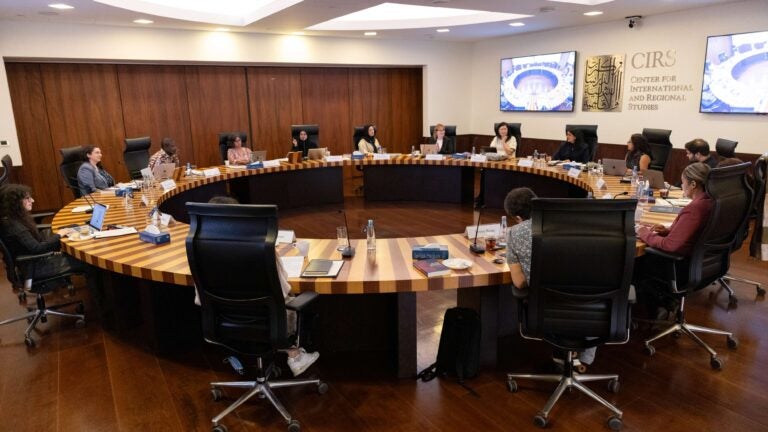
On February 8 and 9, 2026, the Center for International and Regional Studies held a research workshop under its project, Rethinking Migration Categories from the Global South. The purpose of the two-day meeting was to discuss and provide feedback on a collection of draft abstracts submitted for the project. Scholars, working on the topic, were convened for the meeting from around the globe. The topics discussed various aspects of developing theories around categories of migration that are centric to the Global South.
The discussion was initiated by Payal Banerjee, who examined how temporary visa systems transform migrants into specific legal categories that constrain their personhood and rights. She questioned what it means to be “documented,” arguing that legal status involves restrictions and vulnerabilities rather than simply lawfulness. Her proposed paper aims to analyze temporary visa regimes in the US, to understand how visa classifications create hierarchies among migrants and weaken their ability to challenge discrimination based on gender, race, or caste. The research positions visas as instruments of power that shape migrants’ social, economic, and political positioning in destination countries.
In the next session, Rachel Silvey addressed how temporary migration regimes create “stuck movement,” the paradoxical simultaneous production of mobility and immobility for low-wage foreign workers. Drawing on Massey’s “power geometries,” she discussed three dimensions of im/mobility: spatial (border-crossing yet employer-tied), temporal (cyclical contracts creating perpetual temporariness), and social (international movement without occupational advancement). Workers experience involuntary immobility across the migration cycle, waiting before departure, confinement during contracts, and stuckness after return. Her work will examine how legal documentation doesn’t guarantee true mobility, as temporary workers face institutionalized uncertainty and precarity. This im/mobility framework reveals how contemporary migration governance relies on immobilization as a control technique.
Brenda Yeoh talked about the concept of the “developmental migration state” in East and Southeast Asia, where migration governance prioritizes economic development over individual rights. She highlighted how the state employs categorise and control strategies through: hierarchizing migrants by skill levels as proxies for developmental utility; managing degrees and varieties of temporariness to balance market demands with citizenship boundaries; controlling category conversion between migrant statuses; and creating legal versus permissive zones that can transform migrants from “illegal and precarious” to “legal yet precarious.” These power-knowledge techniques divide, differentiate, and discipline migrant populations, reinforcing global hierarchies while obscuring racial and gender prejudices in migration management.
Meron Zeleke then shifted the focus to Ethiopian female migrants in the UAE and how they strategically navigate a highly racialized labor market through skill acquisition and sectoral transitions. Challenging victimhood narratives, she highlighted the female migrants’ agency as they invest in training, from basic domestic skills to beauty industry certifications and marketing courses, to improve their positioning within the UAE’s hierarchical capitalism. While migrants face systematic devaluation based on nationality rather than actual skills, returnees use planned migration and skill upgrades as coping strategies. The research reveals how migrants exercise negotiated agency to achieve limited mobility within racialized structures, though such strategies don’t fundamentally destabilize the racial order underlying labor market inequality.
Zahra Babar presented on the liberal/illiberal binary in migration scholarship that treats Gulf states as exceptional authoritarian cases while positioning liberal democracies as normative baselines. She argued that Western-centric frameworks overlook how liberal states also produce migrant precarity through detention, deportation, welfare exclusion, and legal stratification. Rather than governance failures, Gulf labor regimes, including the kafala system, reveal global logics that render migrants economically essential yet socially excluded. Her proposed work will use the Gulf as theory generating rather than exceptional case, demonstrating structural continuities across political systems in producing differentiated membership and migrant vulnerability.
In the next session, Elena Fiddian-Qasmiyeh examined critiques of three displacement categories, refugee, host, and camp, through Syrian, Palestinian, Iraqi, Lebanese, and Jordanian interlocutors’ perspectives in Lebanon and Jordan. Drawing on 450 interviews, her work challenges bounded categorizations by demonstrating that refugees are hosts and hosts experience displacement, proposing ‘refugee hosts’ as a concept highlighting agency and intersecting identities. Her paper will look at how these labels impose epistemic violence while also offering analytical tools to disentangle complex realities. Using Baddawi camp as a ‘more-than-camp’ hosting multiple displaced populations and ‘camps within camps,’ the intervention aims to move beyond essentialized hierarchies toward relational understandings that recognize displacement’s inherently intertwined nature with hosting.
Bina Fernandez talked about theorizing protection for migrant domestic workers (MDWs) through a feminist international political economy lens on social reproduction. She argued that MDWs are constituted as precarious workers, over-regulated through restrictive immigration policies yet under-regulated in labor protections, serving employer and state interests within global capitalism. Her paper proposes analyzing MDW protection through assemblages of formal and informal social provisioning across origin and destination countries, evaluating whether protections are transformative (replenishing social reproduction) or depleting. Key protection areas include abuse prevention, labor exploitation, health, pregnancy/maternity, social security, and community-based support. The discussion emphasized that inadequate MDW protection isn’t oversight but structural design sustaining gendered, racialized inequalities.
Aashsih Karn shifted the discussion towards Gulf migration and argued for situating the scholarship beyond suffering-centered approaches that reduce migrants to victims of exploitation. While acknowledging labor precarity under systems like Kafala, his paper proposes analyzing Gulf cities as hybrid urban formations where non-citizen life is normalized rather than exceptional. The framework examines three interdependent processes: identity and belonging (how migrants position themselves in stratified urban worlds), place-making (symbolic anchoring of social location), and agency (collective practices sustaining migrant life). The paper aims to conceptualize Gulf cities as composed of distinctive migrant ecosystems, dynamic social worlds characterized by proximity and boundaries, and migrants as social actors who actively produce meaning and sociality under non-citizenship conditions.
In the next session, Faisal Garba Muhammed expressed that mainstream migration studies misrepresent African migration and depict migrants as burdens driven by desperation. His paper aims to decenter Eurocentric frameworks that ignore intra-South mobility and African scholarship. He advocated historicizing migration as integral to African life, not exceptional, including examining the transatlantic slave trade’s legacy in contemporary migration regulation that “wants the body, not the human.” He emphasized that migrants are collective actors in world-making and challenged the narrow nationalist belonging concepts.
In the last session, Anushka Bose looked at passport acquisition as a categorical mobility strategy beyond physical migration. Her work analyzes three citizenship-by-investment programs (golden passports), strategic naturalization through temporary migration, and ancestry-based acquisition as pathways that convert different resources, financial capital, time/bureaucratic compliance, or kinship claims, into second passports. Focusing on the GCC, where passport nationality determines high-skilled workers’ salaries (Western passport holders earning the most, followed by Middle Eastern, then Asian nationals), she questions whether passports proxy for skill or credentials. She proposed treating diverse acquisition pathways as unified categorical mobility strategies, examining how passport capital transforms labor market positioning, especially for expatriates seeking stronger legal anchors while maintaining Gulf-based careers.
The final papers from this workshop will be published as a special issue of a journal by CIRS.
- To view the working group agenda, click here
- To read the participants’ biographies, click here
- Read more about this research initiative
Participants and Discussants:
- Zahra Babar
- Payal Banerjee
- Misba Bhatti
- Anuska Bose
- Maryam Daud
- Nandini Deo
- Mehek Elahi
- Bina Fernandez
- Faisal Garba
- Amanda Garrett
- Noor Hussain
- Syed Taha Kaleem
- Aashish Karn
- Torsten Menge
- Suzi Mirgani
- Honore Mugiraneza
- Shyryn Nurlybek
- Haala Qamar
- Elena Fiddian Qasmiyeh
- Rachel Silvey
- Sabreen Taha
- Brenda S.A. Yeoh FBA
- Meron Zeleke