


CIRS Monthly Dialogue: Asian Migration in a Global Context
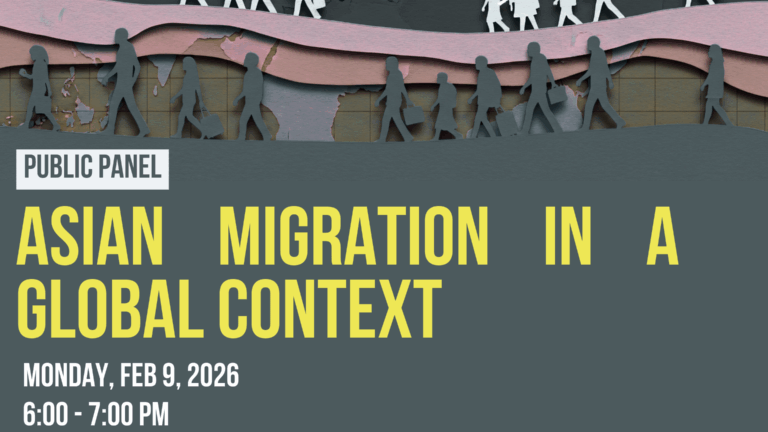
This public panel brings together scholars to examine how migration categories are produced, governed, and contested within Asia and across transnational flows from the Global South to the Global North. Moving beyond fixed labels such as migrant, refugee, skilled worker, or trafficking victim, the discussion explores how state policies, visa regimes, and labor markets shape mobility in practice.
On February 9th, the Center for International and Regional Studies CIRS hosted a public panel featuring scholars from the workshop Rethinking Migration Categories from the Global South. The discussion brought together three panelists, Brenda Yeoh, Payal Banerjee, and Bina Fernandez, to examine how migration regimes classify, control, and at times constrain those who move across borders, with particular attention to perspectives from the Global South.
Brenda Yeoh opened by mapping the dominance of temporary migration regimes across Asia, where pathways to permanent residency or citizenship remain structurally inaccessible for low skilled workers. She critiqued Western centric paradigms in migration studies, highlighting how mechanisms like enclavisation and enclosure, the spatial segregation of migrants and the use of borders as instruments of discipline, function to contain rather than include. Her central provocation was this: how do states design systems explicitly not to integrate migrants, and how should scholars study migration not as states define it, but as migrants actually experience it?
Payal Banerjee drew on her research into Indian IT workers in the United States to examine the mechanics of status dependence, the way a migrant’s legal and economic existence becomes tethered to a single employer. This produces structural vulnerability, including precarious legal standing, limited labor mobility, and chronic anxiety. She connected these individual experiences to broader global asymmetries, arguing that employer sponsored visa regimes are not incidental but deliberate, and that the Indian tech sector’s deep reliance on Western markets reflects wider patterns in which Global South economies remain structurally dependent on Global North capital and labor demand.
Bina Fernandez challenged Eurocentric framings by repositioning Australia within the Asia Pacific region and introducing the concept of “uninvited migrants and settlers” to foreground colonial histories. She critiqued Australia’s offshore detention regime as a calculated deterrence strategy while also noting more hopeful developments, such as the Australia Tuvalu bilateral agreement offering climate linked mobility pathways. She identified three migration regimes deserving particular critical attention: forced deportation regimes, climate and disaster induced displacement, and statelessness.
The panel’s discussion surfaced several cross cutting themes. Participants examined how migration governance increasingly treats human movement as a problem to be managed, with administrative categories serving as tools of state control that generate waiting, anxiety, and unequal power. The rise of AI, biometrics, and surveillance technologies was described as double edged, enhancing border enforcement while also enabling migrants to build digital networks and transnational communities. Panelists also interrogated the politics of labeling itself, noting that categories like “refugee” or “skilled worker” carry colonial and racial histories, and that the global skills hierarchy reframes exclusion through the language of merit. Finally, feminist perspectives on social reproduction highlighted how migrant domestic workers effectively labor for two households simultaneously, with migration redistributing care work globally along gendered and racialized lines.
Article by Maryam Daud, CIRS administrative Assistant and Haala Qamar CIRS Student Assistant
Speakers:
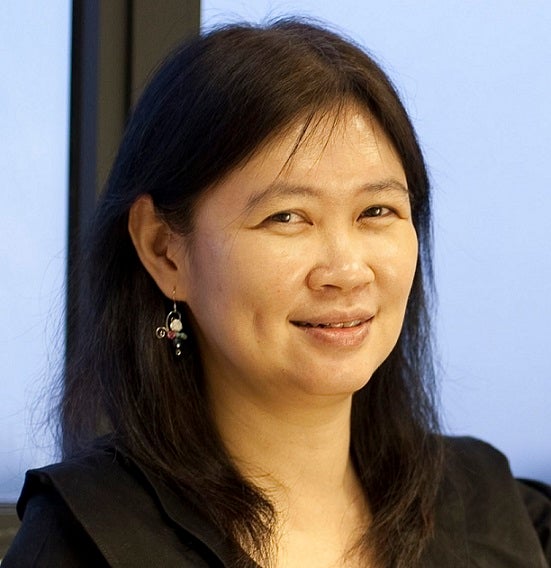
Brenda S.A. Yeoh FBA is Distinguished Professor, National University of Singapore (NUS) and Migration and Mobilities Cluster, at NUS’ Asia Research Institute. She was awarded the Vautrin Lud Prize for outstanding achievements in Geography in 2021 for her contributions to migration and transnationalism studies. Her research interests in Asian migrations span themes including social reproduction and care migration; skilled migration and cosmopolitanism; and marriage migrants and cultural politics.
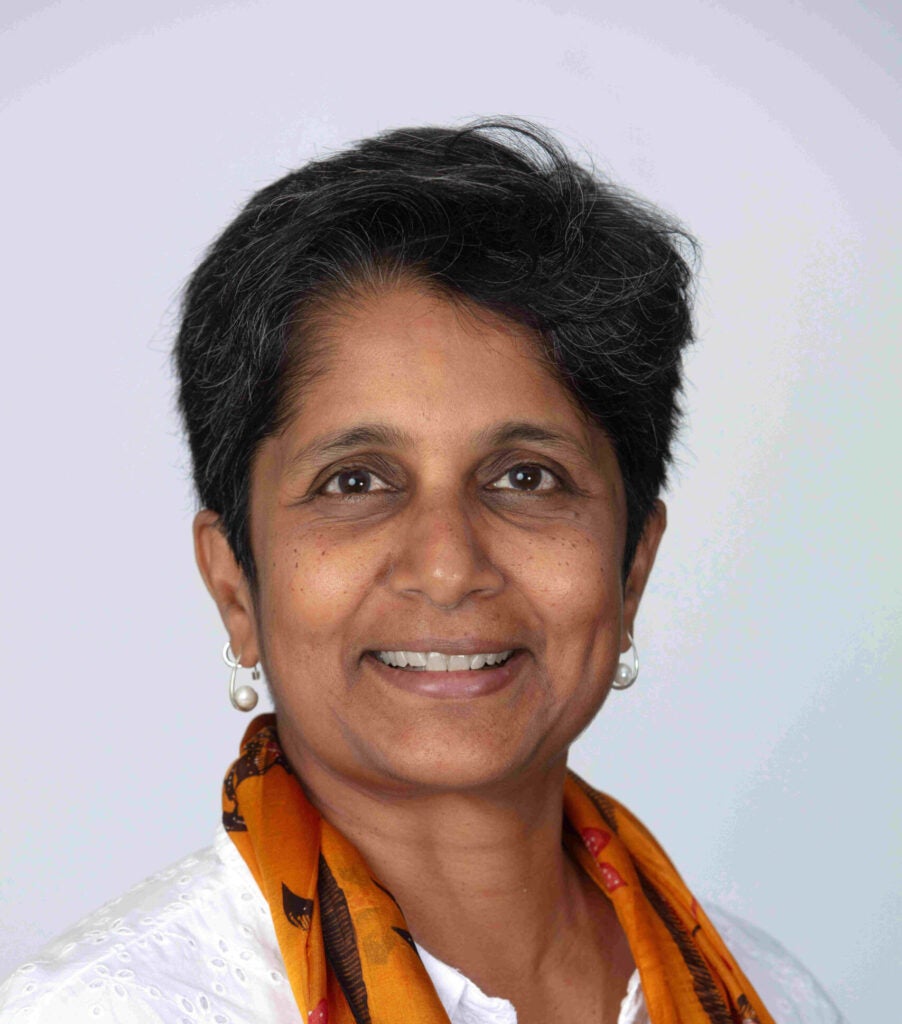
Bina Fernandez is Professor in Development Studies at the University of Melbourne. She obtained PhD and MPhil degrees at the University of Oxford and has held academic positions at the University of Leeds, the Institute of Development Studies, Sussex, the University of Oxford and the University of Oxford-Brookes. Bina’s research focuses on migration and social policy, analysed through the feminist lens of social reproduction. For over a decade, she has conducted multi-sited research on Ethiopian migrant domestic workers in the Middle East; key themes have been the conditions of work, the care needs of migrants, migrant mothers and their children at risk of statelessness. She has also undertaken research on Ethiopian refugees in Kenya and Australia. Current research on ‘Diaspora Humanitarians’ investigates the regenerative contributions of Australia-based migrant and refugee diasporas to the social reproduction of their homeland communities during times of crisis.

Payal Banerjee is Professor of Sociology at Smith College, USA. Her research focuses on the political economies of migration, globalization, and the role of policies in structuring labor incorporation, migrant categories, and status displacement. Banerjee’s work on Indian IT workers in the US has appeared in International Migration, Critical Sociology, Race, Gender, and Class, International Feminist Journal of Politics, Irish Journal of Anthropology, Women’s Studies Quarterly, Social & Public Policy Review, Man in India, and in several edited volumes. Banerjee’s publications on Chinese minorities in India have appeared in Security and Peace, China Report, Asian Journal of Comparative Politics, Huaqiao Huaren Lishi Yanjiu (Overseas Chinese History Studies, in Mandarin), and in the book Doing Time with Nehru. As a Borders Studies Group member, she co-published India China: Rethinking Borders and Security. Banerjee served as a research fellow at the BRICS Policy Center in Rio de Janeiro, Brazil; and, taught at the Graduate Program in International Affairs, The New School in New York City, and in India at Sikkim University in Gangtok and at FLAME in Pune, as visiting faculty.
Moderator:
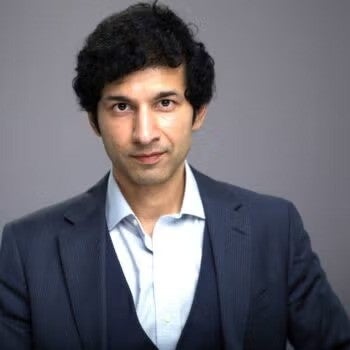
Waleed Ziad is Associate Professor of History at Georgetown University in Qatar. His research interests lie at the intersection of social history, religious studies, and anthropology. Professor Ziad’s scholarship examines the historical and philosophical foundations of Muslim revivalism and mysticism in South and Central Asia and Iran. In this endeavor, he has conducted extensive fieldwork in over 140 towns across Afghanistan, Pakistan, and Uzbekistan. He is the author of Hidden Caliphate: Sufi Saints Beyond the Oxus and Indus (Harvard Press, 2021), which won the prestigious Albert Hourani Prize given by the Middle East Studies Association of North America as well as the American Institute for Pakistan Studies 2022 Book Prize. His most recent book In the Treasure Room of the Sakra King: Votive Coinage from Gandharan Shrines (American Numismatic Society, 2022) builds on his long-standing research into numismatics and material culture of the Indo-Iranian borderlands. His forthcoming book, Sufi Masters of the Afghan Empire: Bibi Sahiba and Her Sacred Networks (Harvard Press), is a continuation of his core research on the development of Sufi networks, spanning modern-day Afghanistan, Uzbekistan, Pakistan, Tajikistan, India, China, and Russia. He has also written extensively on historical and ideological trends in the Muslim world, his work appearing in The New York Times, International Herald Tribune, The Wall Street Journal, Foreign Policy, Christian Science Monitor, and The Hill.