


Migration Studies from the Global South: Rethinking Theory and Method Workshop
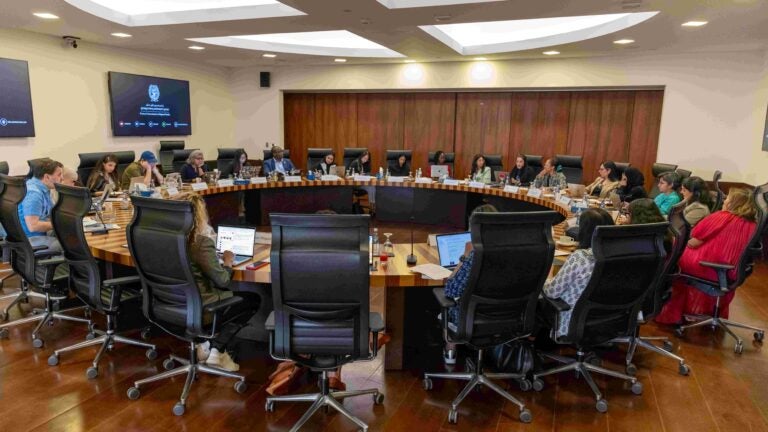
On November 16 and 17, 2025, the Center for International and Regional Studies (CIRS) at Georgetown University in Qatar (GUQ) held a brainstorming session under its research initiative Migration Studies from the Global South: Rethinking Theory and Method. This inaugural meeting brought together scholars and practitioners of migration from the Global South to explore key themes and suggest future research directions. The main themes that emerged from collective sessions and focus groups emphasized a shift towards decolonized, context-specific, and migrant-centric approaches. Throughout the discussions, participants consistently highlighted the need to move beyond Eurocentric perspectives and established categories in migration studies.
The discussion began with a focus on “State Formation, Sovereignty, and Borders.” This session explored how state formation, sovereignty, and borders influence migration patterns. Participants examined why people undertake irregular migration, how migrants cope with challenges, and the role of solidarity and agency in navigating policy obstacles and structural inequalities. The session reimagined sovereignty as a shared concept, questioning its traditional definition, and explored a decolonial perspective on borders, including pre-state migrant political communities. Notably, the focus shifted from receiving states to origin states in migration integration, analyzing sending states’ motivations and migrants’ responses. Discussions covered the Kafala system, theories of the state from the Global South, and challenges to sovereignty through social and cultural dynamics. The session also addressed gender and borders, development finance through diaspora capital, and the complexities of regular and irregular mobilities. Participants emphasized understanding migrant operations at a micro-level, utilizing digitalization, and critically assessing knowledge production in migration studies.
The second session, “Decolonization, Race, and Nationalism,” investigated power modalities, resistance forms, and research methods in migration. The session examined how race and categories shape belonging and wider power structures. The discussion emphasized ‘de-exceptionalizing’ the Gulf region and examined the continuity of colonial power structures through a postcolonial lens on migration. Anti-trafficking policies were scrutinized for blurring consent, differentiating inadequately between trafficking and smuggling, and failing to account for migrants’ coping strategies with coercion. The session stressed the need for decolonizing research through alternative methods and indigenous knowledge while addressing structural inequalities and the power of negotiation. Participants emphasized that decolonization, race, and nationalism carry different meanings across contexts, highlighting the need for both intellectual and institutional decolonization. The definition of the Global South and its role as the “majority world” were also discussed, alongside global mobility, passports, and using social media to amplify migrant voices.
In the next session, “The Problem of Migration Categories,” participants critically analyzed the impact of migration categories, advocating for new vocabularies and a “demigration” of migration studies. The unit of analysis was questioned, and regional variations in existing categories were highlighted, particularly challenging the legal versus illegal distinction as unconventional. A core focus was the need for “categories from below,” advocating for local, indigenous classifications that reflect migrants’ lived experiences and agency rather than state-imposed definitions. The group critiqued white versus non-white binaries and the homogenization of categories for specific jobs. Participants also differentiated between categorization and classification, emphasizing the unstable and evolving nature of these categories and the importance of understanding their contextual meanings.
In the “Identity, Belonging, and Citizenship” session, the discussion explored how racial capitalism constructs identities, often deeming people as “surplus” and producing “hyper mobile citizens.” Participants examined race, class, and identity as intertwined characteristics of citizenship while acknowledging the complex self-identification of people on the move. The discussion included carceral migration, detailing detention tactics and prison-industrial complexes that limit movement. Participants stressed rethinking the citizenship-belonging nexus, questioning traditional notions of loyalty and civic attachment, and contrasting the perceived value of a “strong passport” with actual belonging. Migrant identity mobility, including migrant capital and onward migration, was also analyzed. The session differentiated between “desirable” and “surplus” migrants, critiqued homogeneous categories, and sought new language beyond “blue collar” terms to define migrants. Participants also addressed how migration impacts family structures, called for a post-nationalist liberal theory of citizenship, viewed remittances as a form of belonging, and highlighted the role of networks in providing safety and security.
In the session “Labor, Capitalism, and Political Economy of Migration,” participants examined theories of migration states in the Global South, including nationalization, neoliberal, and developmental approaches, and their impact on sending countries’ economies, with particular attention to the gendered dimensions of remittances. The discussion highlighted the need for better theories on return migration, focusing on reintegration and communication with policymakers. Destination imaginaries were explored, including the evolving perception of the West as a dream destination, transient migration, and alternative routes. Remittances were critically analyzed as both a politically engineered necessity that can create dependency but also as a resource with social, human, and political value. The session also addressed tracking money flows, including reverse remittances and debt circulation, and the challenges of measuring remittances, their household impacts, taxation effects, and diverse uses.
In the next session, “Unpacking Migration and Development,” participants examined the often assumed link between migration and development, labeling it Eurocentric and non-causal. They highlighted the need to rethink this nexus through social transformation and human capabilities while exploring informal economies and their bi-directional impacts. The session sought a Global South epistemology for migration and development, focusing on social processes and knowledge production. Participants highlighted remittances as crucial, often exceeding foreign direct investments, and discussed diaspora contributions to national development through various forms. Climate migration was introduced as a new development issue, linking climate change, security, and human movement. The session questioned restrictions on free movement and promoted using regional knowledge for solutions. Participants critiqued “white saviorism” in migration development and emphasized the practical application of lived experiences. The discussion aimed for a ground-up vision of development, advocating for alternative lexicons and challenging the argument that development reduces migration.
For the session focused on “Gendered Experiences of Migration and Mobility,” participants highlighted the lack of gender-focused policies and data, which renders female migration largely invisible. They emphasized reclaiming human trafficking as a gendered issue vital for migration studies and advocated for research beyond traditional family units. The session highlighted how reintegration often neglects female returnees’ vulnerabilities, urging policies tailored to their specific needs. Participants critiqued governance’s legal focus for overlooking the care economy and transnational care networks, challenging the assumption of women as domestic caregivers regardless of professional background. Data indicate that women send remittances more frequently and in larger amounts than men, often also serving as primary recipients in origin countries and efficiently managing household finances. However, methodological gaps persist, with insufficient data disaggregated by gender and age. The discussion also addressed phenomena such as “self-deportation” triggered by policy changes, gender disparities in digital platforms, and the role of social media in increasing visibility. Migration was considered both a form of protection from and a context for violence. The session highlighted female migrants’ life cycles, the rise of mail-order brides, and the effects of male return on women’s empowerment. It further emphasized the importance of pre- and post-departure orientation and the need to recognize diverse family structures, including single mothers.
In the last session, “Conflict and Climate Mobilities,” participants highlighted the need for community-centric solutions in conflict and climate induced mobilities while addressing citizenship and belonging during displacement. The discussion examined the 1951 Convention’s relevance, advocating for refugees’ self-definition and re-evaluating classification systems. Localized knowledge is crucial for climate mobilities, with participants acknowledging that displacement often stems from both climate change and conflict. The session highlighted trapped populations, such as those with disabilities, who cannot relocate. Participants emphasized communal efforts, in preparing for and reacting to climate events. The health consequences of climate change were also explored, stressing sending states’ and embassies’ roles in awareness and preparedness.
The discussions from this workshop will inform a series of CIRS-led projects, fostering studies and publications on migration that advance innovative theoretical and empirical approaches in and of the Global South.
- To view the working group agenda, click here
- To read the participants’ biographies, click here
Participants and Discussants:
- Rogaia Mustafa Abusharaf, Georgetown University in Qatar
- Idil Akinci, University of Edinburgh
- Haya Al Noaimi, Northwestern University in Qatar
- Hessa Alnuaimi, University of Sharjah
- Zahra Babar, CIRS, Georgetown University in Qatar
- Misba Bhatti, CIRS, Georgetown University in Qatar
- Maryam Daud, CIRS, Georgetown University in Qatar
- Denisse Delgado Vázquez, Georgetown University
- Priya Deshingkar, University of Sussex
- Bina Fernandez, University of Melbourne
- Amanda Garrett, Georgetown University in Qatar
- Noor Hussain, CIRS, Georgetown University in Qatar
- Neelima Jeychandran, Virginia Commonwealth University, Qatar
- Syed Taha Kaleem, PhD candidate at Brandeis University
- Leander Kandilige, University of Ghana
- Anju Mary, New York University Abu Dhabi
- Themrise Khan, Independent Researcher
- Hasan Mahmud, Northwestern University in Qatar
- Suzi Mirgani, CIRS, Georgetown University in Qatar
- Laila Omar, Doha Institute for Graduate Studies
- Linda Adhiambo Oucho, African Migration and Development Policy Centre (AMADPOC)
- Rhacel Salazar Parreñas, Princeton University
- Zarqa Parvez, Georgetown University in Qatar
- Md Mizanur Rahman, Qatar University
- Dina Taha, Doha Institute for Graduate Studies
- Sabreen Taha, CIRS, Georgetown University in Qatar
- Brenda S.A. Yeoh, National University of Singapore (NUS)
- Meron Zeleke, University in Ethiopia
Article by Misba Bhatti, Research Analyst at CIRS