


Student Engagement
CURA Research Presentations
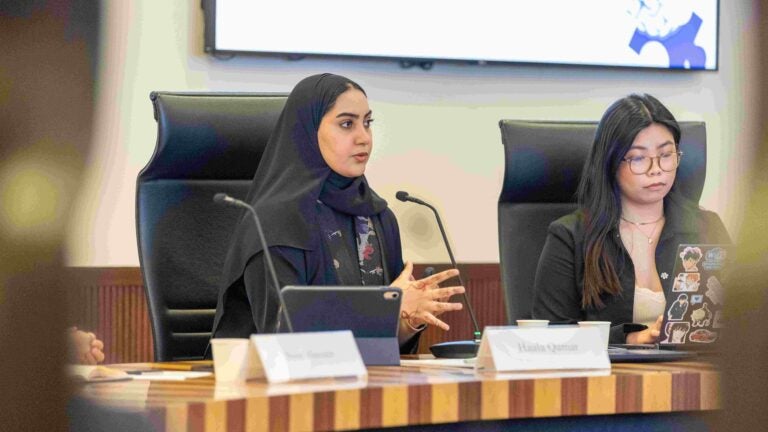
“The Anticipation Gap: South Asian Students in Georgia and the Intersecting Burdens of Discrimination and Aspiration” and “Echoes of Martial Law: Memory, Politics, and the Marcos Restoration in the Philippines”
On October 27, 2025, two student researchers who received Georgetown University in Qatar research grants presented their research findings and methodologies as part of CURA Research Presentation series.
Haala Qamar, a senior majoring in International Economics with a minor in Arabic and a Student Research Assistant at CIRS, presented her research titled The Anticipation Gap: South Asian Students in Georgia & the Intersecting Burdens of Discrimination & Aspiration. Haala examined how South Asian international students in Georgia balanced high educational aspirations with perceived and experienced discrimination. Using a mixed method design, she discussed how anticipation of bias informed academic choices, employment expectations, and coping strategies. She highlighted both emotional and structural dimensions of the anticipation gap and showed how discrimination, whether real or expected, intersected with ambition, identity, and belonging.
Jazmaine Simbulan, an International Politics major with an independent minor in Environmental Humanities and a Research Assistant for both CIRS and the Energy Humanities Department, presented her research titled Echoes of Martial Law: Memory, Politics, and the Marcos Restoration in the Philippines. Simbulan investigated narratives that invoked memory of the Martial Law period and the Marcos regime and explained how those narratives enabled political legitimacy and the subsequent restoration of the Marcos family in government. She situated contemporary discourse within practices of remembrance and forgetting and analyzed how memory shaped national narratives and political outcomes. Through observational analysis Jazmaine noted how museums in Ilocos Norte and Manilla have been sites of sites of political power and historical revisionism. She also reflected on the methodological challenges of working with politicized memory and fragmented archives in the context of state surveillance and authoritarian control in the Philippines.
The session concluded with questions from students, faculty, and staff that focused on research design, ethical considerations, and future directions.
Article by Maryam Daud, CIRS Admin Assistant