


Launch Event: Migrant Stories from Qatar
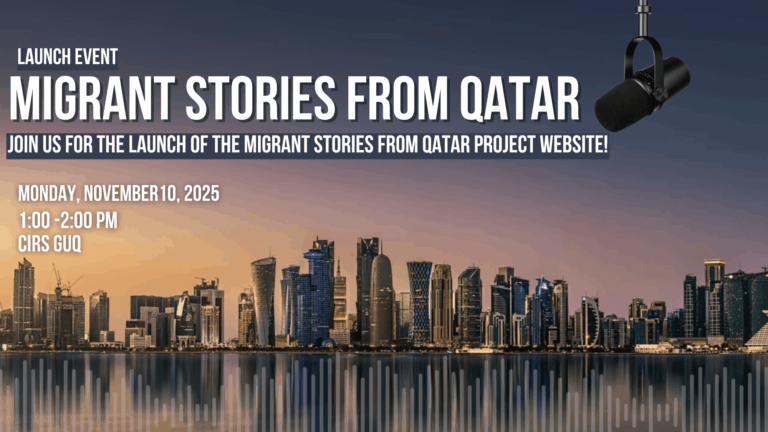
Join us for the launch of the Migrant Stories from Qatar project website!
This project brings together oral histories from migrant workers across Qatar, offering rare insight into their lived experiences and contributions to the country’s social and economic fabric. The six principal investigators will reflect on the research process, its findings, and the broader significance of archiving migrant voices in Qatar, an endeavor that seeks to reframe narratives of labor, belonging, and memory in the Gulf.
On November 10, the Center for International and Regional Studies held the official launch of the Migrant Stories in Qatar project website, a digital platform dedicated to preserving and sharing the lived experiences of migrant workers in Qatar. Conceived as a long–term public resource, the project curates oral histories, testimonials, and personal narratives that illuminate the social worlds, aspirations, and challenges of the migrant communities whose labor has shaped the contemporary Gulf. It seeks to democratize knowledge production by placing migrant workers not merely as subjects of study, but as active contributors and curators of their own histories.
Zahra Babar, the project emerged from intimate exchanges with migrants and from frustration with how their voices are routinely mediated, silenced, or reduced to anonymous data points. The website functions as a counter archive that democratizes knowledge production by coproducing narratives with migrant workers themselves and making these stories accessible to migrants, their families, and wider publics.
Speakers at the launch highlighted the project’s methodological, ethical, and political stakes. Trish Kahle and Nadya Sbaiti situated the archive within broader efforts to document global south histories at a time when formal state archives remain inaccessible, arguing that migrant narratives reveal migrants not as marginal to the Gulf, but as central to its social and economic order.
Noha Aboueldahab drew attention to the global significance of these testimonies, observing that themes of law, its absence, and its uneven application recur across the interviews. She argued that oral histories offer multiple truths that complicate existing legal narratives and have important implications for fields such as international law and transitional justice. Integrating such testimonies into legal analysis, she suggested, could transform understandings of rights, accountability, and lived experience.
The project also involves extensive technical and linguistic labor. Suzi Migani, responsible for recording and editing the English–language podcasts, spoke about the logistical challenges of conducting interviews and the delicate process of editing without inadvertently shaping the narrative. She explained that the platform provides two versions of each interview: a full recording with only identifying details removed, and a shorter public podcast episode of approximately fifteen minutes. Misba Bhatti, who leads editing in hindustaani, described the complexity of translation and the responsibility to convey meaning and emotion with accuracy and integrity.
Together, these interventions articulate Migrant Stories in Qatar as both an archive and a collaborative intellectual project that reclaims authorship for migrant workers in and beyond Qatar.