


Student Engagement
CIRS Open House
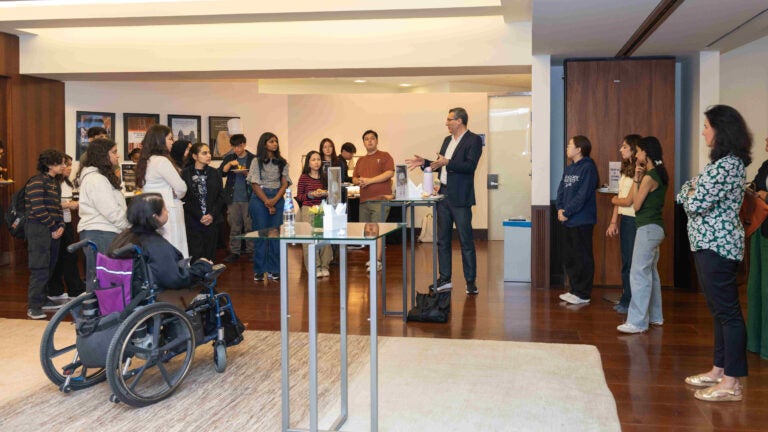
On September 1, 2025, the Center for International and Regional Studies (CIRS) held an open house for GU-Q students, faculty, and staff to learn more about CIRS, the CIRS Undergraduate Research Advancement (CURA) program, and the different ways students can be involved in the Center’s work. Over 25 attendees met CIRS staff members and listened to presentations by Misba Bhatti, Research Analyst at CIRS, and Noor Hussain, Research Program Specialist at CIRS, alongside valuable contributions from Professor Firat Oruc and GU-Q’s Author in Residence, Kamila Shamsie.
In the presentation, Misba outlined the Center’s work in academic research, policy analysis, and its broader thematic clusters. She emphasized the ways in which CIRS organizes its projects under sustained themes, drawing attention not only to long-standing clusters such as regional and environmental studies, but also to new areas of inquiry including race and society, as well as the Center’s growing engagement with the Hiwaraat conference series, an initiative of the Dean’s Office that is closely connected to CIRS’s intellectual mission. She further highlighted the Center’s extensive publications program. Aside from the web-based projects that feature interactive content, CIRS has produced over forty academic publications since 2005, many of which are available in the GU-Q Library and bookstore, with additional titles freely downloadable from the CIRS website.
Noor then expanded on the CURA program, which remains one of the ways for undergraduate students to connect directly with the Center’s work. The CURA program revolves around three interlinked components: student research presentations, research skills workshops, and the Beyond the Headlines series. In research presentations, students are invited to present findings their research findings ranging from honors thesis to class papers to the GU-Q community. These sessions, held as open lunch talks, provide a valuable opportunity for students to practice the art of presenting complex research clearly and concisely, while learning to respond to questions and critique in a professional and intellectually engaged setting.
The CURA workshops introduce students to the craft of research itself, giving them hands-on experience with foundational skills that can be applied across disciplines. Noor drew attention to the upcoming workshop led by Khalid Albaih, GU-Q’s Artist in Residence, on making political art across mediums. This workshop, at once artistic and political, reflects CIRS’s ongoing commitment to expand the boundaries of how research and public engagement are conceived, understood, and practiced on campus.
Misba Bhatti spoke about the Beyond the Headlines series, which provides students with a space to examine current events in greater depth. Panels bring together GU-Q faculty and students to interrogate the historical and cultural contexts behind the news, encouraging dialogue that goes beyond immediate coverage. In these conversations, students consider pressing global issues alongside GU-Q faculty, interrogating the historical context, the silences, and the wider implications that lie beneath the surface of headlines. Students are invited to propose topics and join discussions. Professor Firat Oruc, who moderates the series, also spoke at the open house. He emphasized how Beyond the Headlines offers students a platform to connect their perspectives with faculty expertise and to situate global events within broader intellectual debates.
Professor Oruc also introduced the upcoming Hiwaraat conference, Seeing Sudan: Politics through Art, organized by CIRS. He stressed how the Center is cultivating critical spaces where conflict, displacement, and questions of politics can be interrogated not only through the lens of international relations, but through the textures of culture, art, and literature. He noted how art and cultural production often provide unique avenues to understand the lived experiences of war and authoritarianism, and why they remain central to grasping Sudan’s present and imagining its possible futures. This point was echoed by Kamila Shamsie, GU-Q’s distinguished Author in Residence, who reflected on how poets and writers have historically been among the first voices silenced in times of repression. She drew from her own experiences and authorship and highlighted how listening to artists and poets offers a raw and urgent interpretation of political crises that cannot be captured by official discourse alone.
The event concluded with an open reception, during which students and faculty continued their conversations with CIRS staff, asked questions about the CURA program, and explored concrete ways to become involved in the work of the Center.
Article by Maryam Daud, CIRS Administrative Coordinator